The Last One
by Kit
There was an aura of tired plastic in the coffee shop on the university campus. That reflected Gray's view of himself: weary and unnatural. At this time of day, midway between breakfast and lunch, the cafe would usually have been busier. However, there were only a few thinly spread customers, possibly because it was the last day of the semester before the start of the long summer break.
The young woman behind the counter didn't notice him, and he did nothing to attract her attention. Looking around, his initial impression was that no one there could be his target. Still, whatever it was that guided him had always been reliable. If he hadn't come, it would be like leaving an itch unscratched.
At one table there were three young women, excitedly chatting and probably exchanging juicy gossip. At another table, a young man and woman were talking quietly. It was clear from their smiles and the way they looked at each other that they were a couple, probably having recently started a romance.
In the far corner, a young man sat on his own, eyes squinted and brow furrowed. His elbow rested on the table as he cradled his head in one hand. He raised his mug to his lips, then winced as he sipped his coffee. He almost certainly had a bad hangover. Gray remembered his own experiences of such self-inflicted misery.
The only other customer was a teenager with an untidy mop of brown hair. He sat alone at a table near the large windows opposite the serving counter. The thin black frames and round lenses of his spectacles made him appear to be a cross between Harry Potter and an owl. He had a look of happy expectation, perhaps tinged with nervousness.
As far as Gray could tell, there was no one present who currently required his attention. Perhaps the target would appear soon. He couldn't predict the future, except in the sense that meteorologists may predict the weather. However, it wasn't unknown for him to be drawn toward the location of a future target.
The teenager took his phone from the pocket of his dark grey hoodie, looked at it for a while, and then put it away. Moving closer to him, Gray could tell that he was no longer so happy. The boy was more nervous and was becoming concerned. After a couple of minutes, he took out his phone again, but he put it away when a tall young man entered the room.
The newcomer appeared to be in his early twenties, and some might describe him as classically good-looking. The sharp features under his short black hair gave him an aristocratic appearance, and his body language showed his self-confidence. He scanned the room once, then went directly to the bespectacled teenager, who greeted him with a broad grin which was not returned. Looking serious and uncomfortable, he sat down opposite the younger man. At that distance, Gray couldn't tell what they were saying, but he could easily detect the growing tension between them.
They didn't notice Gray when he sat at a nearby table and observed them more closely. Now he could hear their words, but he didn't need to hear everything to know what was going on. He couldn't read minds and wouldn't have done so even if he could. However, his experience and enhanced empathy gave him the ability to interpret such situations.
"I told you that I couldn't meet you today, Trevor. Why is it so urgent?" the young man said, keeping his voice low to avoid attracting attention.
He was agitated, and Gray could sense that his irritation was fuelled by guilt.
"I wanted to see you before you went home," the teenager replied. "It's a long time until next semester, and I'll miss you until you come back."
"I'm not coming back."
The nervous happiness that Gray had first detected in the boy had now turned into a distressed disbelief. He leaned across the table, seeking secrecy rather than intimacy.
"But… but, Kieran," Trevor stuttered. "What about the rest of the course?"
"This was my final year."
Trevor sat in stunned silence, staring at Kieran, whose blank expression was a sign of his hardened heart.
"You were in your first year when we met. You didn't say it was a two-year course."
"It isn't."
Trevor's shock was compounded by the horrifying thought that he'd been lied to.
"I only applied here because of you," he said, his voice cracking.
"I never asked you to," Kieran replied. His voice tightened as he added, "I never even suggested it."
He sighed, sat back, and then spoke again in a more placatory tone. "Anyway, this is a good university. You can get a decent degree here."
"But I want to be with you. Me and you, together."
"That's not possible. I've got a job and I'm starting a new life away from here."
Trevor jerked back as if he'd been slapped hard in the face. His cheeks, already flushed, reddened even more. He looked around the room to see if anyone was near enough to overhear, but he didn't notice me.
"But I love you, Kieran," he said, tears welling up in his eyes. "And I thought you loved me."
"I liked you as a friend. We had fun. It's time to move on."
The teenager shook his head as if trying to wake from a nightmare.
"You need to grow up," Kieran added. "It's best if you forget about me."
He stood up, and with a dismissive cruelty, he said, "Now, I've got to go and do some packing. Goodbye."
He turned away and strode to the exit, leaving Trevor shocked by the betrayal. Tears began to spill down his cheeks, and he leaned forward to rest his head on his arms. He began to cry silently and didn't seem to care if anyone saw his anguish. As it happened, those who did glance his way pretended not to see him.
Gray was the exception. He saw the teenager and felt his pain, and he didn't look away. Although he yearned to help, he knew that this wasn't the time for any intervention. Hopefully, no intervention would be needed. However, he'd been drawn here, so it was necessary to keep the target under observation until any danger had passed.
Eventually, Trevor took control of himself, stood up and left the cafe. With hunched shoulders, he trudged home to a suburban semi-detached house. Gray followed, knowing that the thirty-five-minute journey time would have been much shorter if it had been made at a normal walking pace.
When Trevor went indoors, Gray waited by the bushes that grew alongside the garden path. His empathic ability usually had a relatively short range. However, once he had acquired a target, his sensitivity to their emotions greatly increased. Thus, he could easily detect the teenager's location and mental state as he went upstairs.
Having just been dumped in a public place, the boy's emotions were mostly predictable. Anger, embarrassment, a sense of betrayal, disappointment, and anguish all roiled together. There was also shame, one of the greatest pointers toward a bad outcome. Gray knew that the fear of ridicule and the prospect of rejection by friends, colleagues, and family could become unbearable. Shame could be a major driver toward a desire for oblivion.
There was no doubt that the teen was miserable and would remain so for some time. Possibly, even now, he might wish that he were dead. A transient wish to be dead wouldn't be very unusual under such circumstances. The situation would become much more dangerous if the desire to die were to become an actual plan for death. Furthermore, if the pain and misery became a dull emptiness, it would be much harder for Gray to prevent a bad outcome.
For a long time, Trevor didn't change his location, so he was presumably staying in his bedroom. At lunchtime, the teenager remained where he was, and there was no sensation of hunger. Gray himself hadn't felt any hunger or thirst for a very long time, and he'd almost forgotten what it had been like to eat, drink, or taste anything.
Although he never slept, and he was never physically tired, he was often emotionally weary. As time went on and as more targets were encountered, that weariness increased. He was grateful that the option of oblivion had been kept open for him.
Trevor didn't move, but Gray could tell that he wasn't sleeping. Late in the afternoon, a woman entered the house, and in the early evening, a man joined her inside. From that distance, Gray couldn't read their emotions, but they generated interference that introduced a slight fuzziness into his reading of Trevor.
Soon after the arrival of the man, presumably his father, Trevor went downstairs, and his previous emotional mix was overlaid by a spike of anger and irritability, followed by resentment. There had probably been some sort of argument. Then he returned upstairs, and Gray was dismayed to feel Trevor's growing sense of shame. Eventually, the boy fell asleep.
Gray remained immobile. Until this critical time was over, he was bound to stay close by. At such times, Gray often felt a little resentful. Although he had agreed to take on this role, a lot of important details had been omitted. Thus, he believed that it hadn't been properly informed consent.
The basic job had seemed relatively simple, though clearly not easy given the obvious difficulties involved. However, there had been no warning about how distressing it could be to feel a target's emotions. There had been no description of what Gray's abilities or limitations would be. Above all, there had been no clear definition of 'success', though at least one form of failure was obvious.
More and more frequently, Gray had been wondering if he'd made the right decision when he'd accepted this task. While Trevor remained asleep, Gray's thoughts drifted to the circumstances under which the offer had been made.
There was no way of knowing how long he drifted in total darkness; there wasn't even the beating of a heart to mark the passage of time. Gray's growing concern was beginning to become a panic. Then a voice without sound, totally flat and emotionless, impinged on his consciousness.
"Greetings," it said.
"Who are you?"
"A messenger."
"What's your name?"
"I do not have a name."
"But I have to call you something."
"Why? I am simply a messenger. However, if it is convenient for you, then you may choose a name."
He never understood why he chose 'Ariel'. Also, although he somehow knew the being had no gender, he chose to think of Ariel as 'he'.
"Am I in Hell?" he asked, remembering his last thoughts before this darkness.
"There is no Hell. Just life or oblivion."
"Then where am I?"
"On the threshold of oblivion, the last choice you made. Now you are being given a chance to make another choice. Accept a task or cross the threshold."
Gray remembered that last choice, followed by the thoughts as he fell and the final emotions just before he hit the water.
"Why am I being given another chance?"
"In your last moments, you felt regret and wanted forgiveness. Asking for forgiveness indicates hope for forgiveness. Hope is the opposite of oblivion."
Confused and disoriented in the darkness, Gray couldn't really grasp the meaning of those words. However, his mind gravitated toward obvious questions.
"And what choice must I make? What task could I accept?"
"You must help others who seek oblivion. You can show them that there are options and that they can choose hope."
That seemed to be a far-from-easy task, and knowing his own background, failure would be likely. Remembering his previous decision and the guilty shame that had led to it, oblivion still seemed relatively attractive. However, he had nothing to lose by continuing the conversation.
"What if I can't get to them in time or if I can't help them?" he asked.
"Then that is how it will be."
That enigmatic response was irritating, and the flat tone made it difficult to determine his intentions. The fact that Gray couldn't see Ariel made the words even harder to interpret. Perhaps Ariel didn't display emotion because he never felt emotion. Perhaps he was lying and this was Hell, and maybe he was a demon sent to taunt him.
"I'm not a therapist or a psychologist."
"That is not necessary for emergency situations."
"So I'd be expected to deal just with emergencies? But I don't even know how to do that."
"You already have strong empathy and the experience of what it is like to want oblivion. Also, if you accept this offer, you will gain some extra skills."
"What skills?"
"Different agents develop different skills," Ariel said, providing another irritating example of his unhelpful responses.
"So I'm not the only one?"
"Are you so arrogant that you consider yourself to be unique?"
Perhaps that was intended to be an insult, but with the voice lacking any inflection, Gray couldn't be sure.
"Well, no. But what if I fail? It will be my fault if someone dies."
"Whether you succeed or fail, they have free will. You cannot direct them; you can merely help them to see that there are possibilities outside their narrow vision."
At that point, the prospect of oblivion didn't seem too bad to Gray. The alternative was an unknown future and the likelihood of failure. However, after much thought and prolonged uncertainty, he set aside his doubts. Hope won in his internal debate.
"Is there a particular number of people I'm expected to save?"
"No. You must help others until you learn and gain understanding."
"But that could take forever. Is there a time limit?"
"Humans do not understand time, and I do not understand how humans perceive time. If you are open to learning, the task can be concluded successfully."
Gray wondered if Ariel might be immortal. In which case, his view of time would be different, and a human lifetime would be insignificant.
"And what happens if I succeed?"
"You may choose life."
"What does that mean? What sort of life?"
"I don't know. You will have to discover that for yourself."
"How long do I have to decide?" Gray asked, hesitating to commit myself.
"You are creating your own time. You can decide to step over the threshold, but until you choose, you remain here as you are."
"Alone in the darkness?"
"What is darkness? But alone, yes. I will know if you accept the task, and then I will return."
The thought of spending any extended period alone and disembodied in darkness was terrifying. Gray played for time.
"Is this a test or a punishment?" he asked.
"It is only a test if you decide that you're testing yourself. It's an opportunity to learn, though you may feel that it's a punishment."
Gray was beginning to become accustomed to the cryptic and enigmatic way in which Ariel communicated. Perhaps the being considered Gray to be like a child. Trying to understand Ariel's words in that context, he thought of a possible analogy. When a child is made to get out of bed early and go to school on a cold, wet, dark winter morning, it may feel like a punishment, despite the intentions of the parent.
"If I can complete the task, will it show that I'm worthy of life?" Gray asked, remembering how unworthy he'd felt when he made his last decision.
"You misunderstand. It is not about being worthy. You are not being judged unless you judge yourself. This task is set so that you can decide if you are capable of life. You need to learn to want life. You need to be able to value not only your own life but also the lives of others. You need to understand the capacity to hope."
Although that was the longest and perhaps least enigmatic series of words that Ariel had shared, it still took some time for Gray to understand the meaning. Ariel remained silent. Gray wondered if the entity was being patient or if he was even still there. He panicked at the thought of being alone and blurted out one last question.
"And if I accept now, can I change my mind later?"
"You can choose to cross the threshold whenever you wish. You do not have to complete the task."
Thus, he had become what he was now. He was not a ghost; he had substance, he could touch objects, and he couldn't pass through walls. He was not alive, but he was not dead; he remained on the threshold of oblivion. He could be in the world, and he could move as humans did. He could see and hear, but he could only be seen and heard when he chose to interact with someone.
With experience, Gray had learned about his new skills and how best to use them. He'd also discovered his limitations, some of which were inherent and others that had been imposed upon him. It seemed unfair that he'd had to learn these things for himself. He wondered how many more people he might have helped if he'd had that knowledge in advance.
He still didn't know whether it was his own instinct or some external influence that guided him toward those in need of help. Having found his target, he could sense their misery, anguish, and mental pain. That was a very unpleasant part of Gray's task, but he'd developed the ability to tolerate it.
Over time, he discovered that he could not only read emotions but, with a target, he could also modulate them, at least for a short time. Although he couldn't create or remove an emotion, he could change the intensity. He could also appear to a target and communicate with them.
His aim was to help those undergoing an acute emotional crisis by providing balance and perspective. However, the only thing that he could do for those with chronic problems was to try to guide them to get professional help. He began to compare himself to a paramedic trying to keep a patient alive until they get to the hospital.
Perhaps the most important limitation was that he could never physically interfere, even when the target was taking active steps toward ending their life. Thus, he sometimes failed, and his target died. Gray would share their emotions during the last few seconds of their consciousness and the moment of terminal emptiness. It was by far the worst part of his job, and there had been occasions when he'd almost chosen his own oblivion.
Other parts of his current existence felt strange but not really unpleasant. For example, when he wasn't dealing with a target, his consciousness just drifted in a sort of limbo with no sense of time. He could move easily within a particular area, but unless he was with a target, moving outside that area engendered a strong desire to return. Also, it was completely impossible for him to go to any of the places that he'd visited in life.
He had no idea what Ariel would count as a success or failure. However, he presumed that the entity was monitoring his progress and would inform him if the task was completed. Until then, all he could do was to continue his work or choose oblivion.
Waiting outside Trevor's home throughout the night, Gray wondered if any of those other agents that Ariel had referred to ever regarded their existence as a sort of purgatory. However, he couldn't ask them because he'd never encountered anyone like himself. Perhaps there were just a few spread thinly throughout the world. Perhaps they were deliberately hidden from one another.
Trevor's sleep didn't last long, and in the early hours of the morning, Gray felt the trickle of sleeping sadness become a deluge of misery and despair. Unfortunately, at that distance, he was unable to modulate the cascade of negative emotions, so they both had to suffer. When the teenager eventually went downstairs, there was the emotional profile of another argument, and then he came out of the house.
Gray could feel that Trevor was trapped in his own cold, dark mental tunnel. The boy didn't notice the lovely sunshine on that warm summer morning. Anger seethed on top of the other emotions as he walked along the street, but then shame became dominant. Concerned, Gray tried to damp down that dangerous emotion.
No one, not even the driver, noticed him as he followed Trevor onto the half-empty bus. When Trevor got off, he walked a short distance to a large park. Even though it was a mild and sunny Saturday morning, there were relatively few people there, apart from football players on a couple of pitches. He sat on a bench in a relatively isolated area partially concealed by bushes and a small clump of trees.
His emotions calmed a little, and they were now accompanied by a trace of comfortable familiarity. Gray guessed that this place must hold a special significance. Deciding that it was now time for interaction, he approached the teenager.
"Do you mind if I sit here?"
Trevor looked up, and his initial irritation quickly turned into confusion.
"Grandad?" he said. Blinking and shaking his head, he added, "Sorry. I thought…"
After the wave of embarrassment, there were ripples of sadness and nostalgia.
People never noticed Gray at all unless he deliberately drew their attention, and then they would perceive him as someone trustworthy and completely non-threatening. Almost all females and the majority of males saw him as an older woman. This was the first time that he'd been perceived as a grandfather.
For some reason, being considered to be a grandfather made him feel more uncomfortable than being seen as an 'auntie' figure. However, his own comfort was irrelevant. He sat down, maintaining maximum distance between himself and the teenager.
"People often mistake me for someone else," he commented. "Maybe I have a generic face."
Trevor found the attempt at humour puzzling rather than amusing and returned his gaze to the ground between his feet. Gray looked into the distance and remained silent.
"I didn't really think you were my grandad," Trevor said eventually. He looked up but avoided eye contact. "He died years ago, but we used to come here a lot. So I was just thinking about him when you spoke to me."
"That's okay. I can tell that you have a lot on your mind."
After a few minutes of silence, Gray judged that the time was right to terminate this first meeting.
"This is a really nice place. Very calming," he said as he stood up. "I'll definitely come here again, but I should go now. Bye."
He turned away and walked past the trees. Once Trevor could no longer see him, he discontinued his interaction mode and returned to the default condition of being unnoticeable even to his target. He was pleased that the tentative and brief first contact had been achieved without friction. That could provide a foundation for future meetings. As a target, Trevor would remember any interactions with Gray, whereas all others who ever interacted with Gray would forget that they ever saw him.
Staying behind the trees, Gray continued to monitor the teenager's emotional state, which was now a little less concerning than it had been when he'd left home. However, Gray knew from experience that moods could be very volatile under such circumstances. Pain and misery could flare up, or there could be a sudden drop into depression.
When Trevor eventually got up and moved toward the park entrance, it was almost noon. Instead of going home, he took a different bus to the centre of town. Gray was concerned that the teenager didn't eat and wasn't even slightly hungry. There were undercurrents of nostalgia and sadness, but also a feeling of comfort as Trevor approached the museum.
The inside of the Victorian stone building had been extensively modernised, and Trevor wandered around for a couple of hours. He spent most of his time either in the geological section or staring pensively at the ancient history exhibits. Then he returned home, where there were more arguments. That night, the teenager had very little sleep.
The next day, Sunday, Trevor got up before his parents and rode the bus to the park. Although the weather was cloudy and cooler than the previous day, he still wore the same light clothes. Anticipating the boy's destination, Gray went directly to the bench, ensuring that he arrived there first. When Trevor saw Gray, he stopped dead in his tracks. After the initial surprise, there was a build-up of anxiety, which Gray modulated downward.
"Hello again," Gray said. "I hope you don't feel that I'm taking over your bench, but it's such a beautiful spot. Anyway, I leave if you want."
The teenager briefly considered leaving, but the presence of the man who reminded him of his grandfather was somehow comforting.
"Erm, it's okay," he said.
After a moment of hesitation, he went to sit at the far end of the bench. Now he could see that the man didn't look anything like his grandfather. Apart from anything else, he was considerably younger. Despite that, there was something about him that reminded Trevor of his grandfather, who'd always made him feel safe and secure.
No matter what the problem, his grandfather had provided comfort and reassurance. Trevor could tell him anything without fearing judgement, and he could trust him with any secret. He was convinced that life would be more bearable now if the old man were still alive.
Gray didn't know what thoughts generated the emotions that he could read, but it was clear that this place was special and probably associated with happy memories. After his experiences with other targets, monitoring and occasionally tweaking emotions was something that Gray could do almost automatically. Thus, his mind was able to entertain other thoughts.
His empathic abilities always made him care about his targets. However, he usually tried to be detached and analytical because he knew that he could get caught up in their emotions. Then it would be much more difficult to help them. With other targets, he'd never taken the risk of getting involved in potentially dangerous emotional situations. However, being with Trevor was different. Gray was beginning to feel an attachment. Surprising himself, he felt that perhaps it would be worth taking a risk if he could help the teenager.
He wondered why Trevor affected him differently from previous targets. Of course, he had cared about all of them. Sharing someone's emotions, even when unpleasant, always formed some sort of bond. When he tried to help them, the outcome was important to him not only for their sake but also for his own need to complete the task.
He tried to work out why the situation felt different with Trevor, and it occurred to him that perhaps it was related to the subtle difference between 'cared about' and 'cared for'. He'd cared about previous targets and the outcome of his efforts. However, he found that he actually cared for Trevor as a person.
Suddenly, it became clear to Gray that Trevor wasn't just a task to be completed. He found himself caring for the teenager as if he were a vulnerable younger sibling. Gray had often wondered what it would be like to have a little brother. However, thinking of Trevor as a little brother was worrying. He was concerned that could make the task more difficult and less likely to end in success.
Trevor was grateful that the man had remained silent and hadn't tried to impose an unwanted conversation on him. Looking up, he saw that Gray was staring straight ahead and appeared to be lost in his own thoughts. The teenager found that reassuring as he remembered that he and his grandfather had often sat together in comfortable silence.
"It's odd that I've seen you here twice in two days, but I've never seen you around before," he commented.
Gray detected curiosity rather than suspicion, but he still replied cautiously.
"You've not seen me before because I've only been in town for a few days. When I found this place, it seemed like a good place for quiet relaxation, so I came again today."
"How long will you be staying in town?"
"I don't know. It depends on when I feel I should move on."
"You're lucky," Trevor said bitterly. "I wish I could be free like that."
Gray didn't comment, and after a brief pause, Trevor spoke again.
"I hope you weren't annoyed that I called you 'Grandad'. I mean, you're obviously way too young to be my grandad."
"Of course I wasn't annoyed. In fact it was quite flattering that you mistook me for someone who was special to you. I get the feeling that two of you were close and that maybe you still miss him. If you want to talk about him, I'd be happy to listen."
Trevor didn't respond and turned his gaze toward a sparrow that had just alighted on the ground next to the bushes. The boy's raw emotions were no longer distracted by conversation and immediately boiled up to the surface. Gray remained silent, monitoring and modulating. After a few minutes, he decided that this would be an appropriate point to end their second meeting. He stood up.
"Time for me to go," he said. "This is a nice spot, so maybe I'll see you again."
Trevor merely nodded his head. However, just as Gray was walking away, he spoke.
"If it's raining, the shelter behind the bandstand is a good place to sit and think."
Trevor went home at lunchtime, though he wasn't really hungry. Having Sunday lunch with his parents was expected of him, and he didn't have the energy for confrontation. He spent the afternoon upstairs while Gray remained on duty outside. In the evening, the teenager went downstairs, where he stayed for almost an hour, presumably for a meal.
During that time, his anxiety increased to a peak, and then there were all the emotions associated with arguing. When Trevor went upstairs again, Gray was very concerned that the anger and resentment faded while shame and guilt became dominant. He knew that those two emotions were more dangerous than others and that in combination they could prove deadly.
That night, Trevor again slept very little, and Gray was in a constant state of worry. The next morning, with the boy still upstairs, there was another argument before the parents left for work. As they passed close by him, Gray could sense their frustration, annoyance, and concern. Trevor's feelings of guilt and shame again dominated, but the pain of rejection and betrayal were not diminished.
Eventually, exhaustion allowed Trevor to fall into a troubled sleep. Gray remained very concerned, but he knew that there was little he could do until the teenager left the house. After about four hours, the boy woke up and went downstairs. A little later he left the house wearing a dark green cagoule.
Gray hadn't noticed the light rain until he saw what the teenager was wearing. He wondered if Trevor would go to the shelter behind the bandstand in the park. On the surface, the boy's mind was calmer. The anger and resentment as well as more painful emotions were dulled, and there seemed to be an acceptance of his situation. However, Gray knew that was probably not a good sign, especially as guilt was beginning to predominate. He wondered what the teenager could be feeling guilty about. After all, Trevor was the victim who'd been used and betrayed.
Trevor didn't go to the park, but instead, he went to the museum. Gray grew more concerned when the boy spent a long time staring at a life-sized model of an Egyptian mummy. Even more alarming was that envy was a noticeable component of his emotions. Then Trevor went to the nearby library, picked a book from a shelf in the reference section, and found a quiet corner to sit in.
Although he opened the book, he just stared at it without reading. Gray assumed that this was a place that Trevor occasionally came to for quiet contemplation. From the emotional context, he guessed that it might be associated with the boy's grandfather. Gradually, all of the teenager's emotions seemed to fade and combine into a dull ache, leaving nothing that Gray could modulate.
That evening, Gray didn't detect any signs of Trevor having an argument. The boy spent almost all of his time upstairs, his mood becoming increasingly bleak. It seemed as if he were becoming resigned to an unpleasant fate. The next morning, Trevor went downstairs before his parents left the house. Whatever interaction they might have had produced little change in the teenager's mood.
There was a little light rain, and Trevor was again wearing his cagoule when he left the house. This time, he went to the park, and Gray ensured that he got to the shelter ahead of the boy. He sensed that Trevor was mildly but pleasantly surprised when he saw that Gray was already there. With a brief nod of greeting, Trevor sat at the far end of the bench, and they both looked out across the grass and flower beds toward the bandstand.
"You don't have an umbrella," Trevor commented, startling Gray.
"Neither do you."
"But I've got a cagoule."
Gray had no control over how he appeared to others, and normally how they saw his clothing didn't matter. He wondered what Trevor thought he was wearing.
"I don't mind a little light summer rain."
"That's what Grandad would say. He said it was refreshing if you wore the right clothes, kept warm, and dried off when you got home."
"I think I would've liked your grandad," Gray replied, amplifying the boy's positive emotions.
"Everybody liked Grandad."
"I'm sure you still miss him."
Gray knew better than to ask specific questions, so he just waited patiently to see if Trevor would respond. Eventually, he did.
"When I was little, he looked after me while Mum and Dad were at work. He took me to lots of places, and we both liked being outside more than inside."
"So do I."
There was a long pause before Trevor spoke again, and Gray sensed the uncertainty as he was trying to make a decision.
"My name's Trevor," he said eventually.
"Mine's Gray."
"Is that your first name? Or should I call you Mr Gray?"
"You can just call me Gray."
There was another long pause before Trevor spoke again.
"You said you've not been in town long."
"Just a few days, but I like what I've seen so far."
"How long are you staying? If you like exploring outdoor places, I can tell you about a few of my favourites."
"I'm not sure how long, but I'd love to have your recommendations of places to see."
As Trevor briefly listed a few local areas and explained why he liked them, his mood became lighter. Gray guessed that these were places that the boy associated with happy times spent with his grandfather.
"When I was older, Grandad took me on day trips to some places that were a long way from here. He told my mum and dad that we were going for 'a grand day out'." Trevor flashed a small wistful smile. "I really liked it when he took me to the seaside."
There was a sudden wave of embarrassment and concern, as if the boy feared that he'd revealed too much to this stranger. He stood up.
"I've got to go now," he said.
"Okay," Gray replied. "It was really nice talking with you, Trevor. And thanks for the advice on places to visit."
Trevor turned to go, but before leaving the shelter, he glanced over his shoulder.
"I'll probably come to the park tomorrow. Here if it's raining."
As soon as Trevor was out of sight, Gray switched out of interaction mode and followed him home.
The next morning was fine, and Gray waited for several minutes after Trevor sat on the bench before revealing himself and joining him. Although the boy's greeting was just a brief nod, Gray was pleased that the boy was glad to see him. Most of the time they sat in silence, but Trevor also mentioned a couple of his favourite trips with his grandfather. Gray boosted the happy emotions associated with those memories.
"You can still visit those places and explore new places in the future," he pointed out. "Of course, it won't be the same without your grandad, but I'm sure you'll find friends to go with."
Trevor didn't respond, and a few minutes later, Gray sensed that the teenager wanted to be alone, so he stood up.
"Well, I should go now," he said. "As always, it's been a pleasure to see you."
"Do you know the museum in the town centre?" Trevor asked before Gray could leave.
"Yes, I know where it is."
"I'll probably be there tomorrow morning."
That provided a sort of template for their future interactions. Trevor never arranged to meet, and he never even suggested that he might see Gray again. However, he always ended a meeting by announcing where he would be at a particular part of a day in the near future, often the next day. Gray took the hint.
Over the next few days, Trevor occasionally shared memories associated with his grandfather. However, he never talked about negative feelings, though Gray could sense those feelings, including the pain and sadness that he assumed were linked to Kieran. At first, Gray thought that the things were proceeding well. However, he was worried by the continued shame and increasing guilt.
He couldn't understand why those emotions were present at all in such strength, and he was even more baffled by the fact that the guilt was increasing. After almost two weeks, he could sense that Trevor was feeling trapped and was increasingly despairing. He realised that tweaking and modulating wouldn't be enough.
Often, it wasn't useful to address a topic of concern directly when speaking with a target, but Gray was getting worried. The more time that he spent with Trevor, the more he'd come to care for him. As a task, this was no longer important to Gray, but it was essential that the boy be helped toward a long and happy life. After more than a dozen meetings, Trevor was still feeling increasing despair.
Gray decided to raise the matter when they were sitting on the bench by the trees and bushes. It didn't take an empath to know that Trevor was miserable and trying to hide it. Thus, Gray would not be revealing his ability.
"You've seemed unhappy for the past few days. Is there a problem? After all, I think we're friends now, so you can talk to me about anything."
Trevor looked directly at him and frowned. After a few seconds, he reached a decision, and Gray felt an undertone of relief below the boy's anxiety.
"It's about university," Trevor began hesitantly. "I accepted an offer to go to the local uni, but now I don't want to go."
He studied Gray, who didn't need any special powers to know that the boy was concerned about how he might react and if there would be questions about his reasons. Of course, Gray didn't need to ask.
"Why not just choose a different university?"
"It's not as simple as that," Trevor replied, making no attempt to hide his frustration.
"Things are never really simple, but no matter how difficult things are, you always have options. Problems can be solved."
"Grandad used to say that a problem is just something you haven't solved yet," Trevor conceded. "But he didn't have parents telling him what to do."
"So I suppose that you've already talked about this with your parents."
"Yeah. Well, it wasn't really talking. I told them I'm definitely not going there, and they just started lecturing me. Apparently, I'm ungrateful, stupid, and inconsiderate," Trevor replied bitterly. "They said that I accepted the offer and shouldn't mess people about by changing my mind."
"People should always be free to change their minds when that doesn't hurt others. You can't hurt yourself just to avoid inconvenience to others."
"They said by going to this university I could live at home and save money. And they said that if I withdraw, I may not get another offer and won't be able to go to uni this year."
Gray thought for a while before responding. Despite the fact that Trevor saw him as an older man, it had in fact not been long since he'd applied to universities.
"Exam results aren't out yet, so if your offer was conditional, the university can't be sure that you'd be going there, anyway."
"I'm sure my results will be good enough."
"You know about Clearing, right? People who don't get into the university they wanted can apply for spare places at others." Trevor nodded, so Gray continued, "If you withdraw now and get good results, you could get into another university through Clearing. What course were you going to be on?"
"Electronics and Electrical Engineering."
"I'm pretty sure there will be places in some universities through Clearing if you get good exam results."
"But what about Mum and Dad?"
Gray thought about that for a few seconds before responding.
"I'm guessing that you just told them that you want to withdraw. That's just negative. You need to offer some positive alternatives."
"What do you mean?"
"Instead of just saying that you don't want to go to that particular university, you tell them there are other places you want to go to. Show them a list of universities that are at least as good. Maybe you could look up the courses and explain why you prefer them. Find statistics about previous years' Clearing placements on those courses."
"Do you think they'll take any notice even if I do of all that?" Trevor asked, doubt mixed with hope.
"Most parents want what's best for their children, so I'm pretty sure yours will at least give it serious consideration. You need to show them positive aspects of going to a different university and to let them see that you're enthusiastic."
"Okay, I'll give it a try."
When the two of them met up a couple of days later, Trevor was happier. There was still pain, anger, and resentment related to Kieran, but it no longer dominated his mind. Most importantly, the guilt was almost gone.
"You were right," he told Gray. "They still aren't happy with the idea of me declining the offer, but they said they'd support my decision to go to a different uni. Actually, Dad seemed impressed by some of the other courses that I said I could apply for."
"That's great. I'm really happy for you."
He continued to monitor Trevor for almost two weeks, just in case there were signs of a relapse, but he felt reasonably confident that his job was done. Trevor still had much sadness, both deep and near the surface. Perhaps the pain of betrayal would never go away completely, but those were the sort of things that many people lived with.
It was possible that soon Gray would be given a new task, though he suspected that Trevor could be the last one. In either case, he would probably never see Trevor again, and that saddened him.
"When I go away to uni, we won't be able to meet up," Trevor said regretfully during one of their last meetings. "But maybe we could stay in touch."
"I'll have to be moving on soon, and I'm not sure where I'll be going."
"Okay," Trevor said sadly. Then, blushing with embarrassment, he added, "I'm glad that we met."
"So am I."
Gray was suspended alone in the darkness. This time, it felt even more empty than before. Of course, he knew that was ridiculous. After all, how could something be emptier than nothingness? Perhaps it was like feeling the absence of someone. After an indeterminate time, there was a voice without sound.
"Your task is complete," Ariel said. "Now you have the possibility to choose life."
"So Trevor was the last one? Sometimes, with some people, I wasn't sure if I'd really helped."
"He was the last one. You helped. You gained a little understanding."
"Good. But it took me so long, and I lost track of time."
"You did not gain an understanding of time."
Gray had already decided to choose life, and he suspected that Ariel knew that. However, there was something on his mind.
"Can I ask a favour? Before I tell you my choice, can I make sure that Trevor is really going to be okay?"
"I am a messenger. I do not make such decisions."
Despite his disappointment at not being able to know for sure, Gray was hopeful that Trevor would have a long and happy life.
"I choose life," he said.
Dazed and confused, he lay still until the pressure of gravel on his chest prompted him to roll over and sit up. He was wet and was beginning to feel the chill as he looked around. It was dark, but there was a little light from streetlights in the near-distance. He could see that he was on the banks of a wide, fast-flowing river. His first coherent thought was to wonder why he was so pleased that he could smell mud.
Then memory returned. His last memory was of falling and smashing into water after he'd jumped from the bridge. He had a bizarre thought: perhaps the water had rejected him and thrown him up onto the riverbank. Then he realised that hitting the water so hard would surely have injured his body, yet he felt no pain and everything seemed to be working normally.
Furthermore, although he was soaking wet, there was no water in his lungs. For some reason, he giggled when he discovered the fact that there wasn't even any water in his ears. That brief moment of almost hysterical relief made him think that he might be insane.
It was raining steadily but not heavily, and he wondered if that was the reason he was wet. Perhaps he hadn't been in the river, and maybe jumping from the bridge had been a dream. Yet it felt as real as his other memories, and what he was experiencing now on this riverbank felt equally real. He staggered to his feet and looked around.
Now he recognised where he was; it was less than a mile from his home. However, the bridge from which he'd jumped was a couple of miles downstream from here. How could he have passively drifted upstream? He experienced a wave of disorientation that made him feel nauseous. Pulling himself together, he tried to think logically.
Assuming this was real, he remembered what clothes he'd been wearing and that he'd deliberately left his watch and his phone at home. The clothes he now wore were the same, though a little tattered, and there was no watch on his wrist. He remembered leaving the house at about eleven thirty. If this was the same night, then it must now be in the early hours of the morning, possibly close to dawn.
Shivering, he started walking home, grateful that the streets were deserted. His shoes squelched with every step, and his wet clothes clung uncomfortably to his body, so he increased his pace until he was almost running. As he approached his house, he became more convinced that this was real and not a dream.
When he got inside, he noted that it was about three hours after he remembered leaving. He'd deliberately chosen a weekend when his parents were visiting his sister and her husband, so he tested that memory by checking all the rooms in the house. The fact that he was alone in the house reinforced his belief that this was indeed reality.
As he undressed in the bathroom and threw his clothes onto the floor, he was overcome with a weariness that included his spirit as well as his body. He no longer had enough energy to take a shower, and he just rubbed a couple of towels over his body before collapsing onto his bed. The rapid arrival of sleep temporarily separated him from his concerns about reality.
Despite several unpleasant dreams that he couldn't remember and the usual nightmare that he couldn't forget, he woke up feeling physically refreshed. However, the nightmare reminded him of the guilt and shame that had led him to the bridge. That was now compounded with the additional guilt and shame that he now felt about trying to end his life. His only solace was that no one would ever know.
He never really understood what happened that night, and the ideas he came up with all had logical flaws or inconsistencies. If he'd actually jumped off the bridge, how had he survived unharmed and emerged upstream? If jumping had been an hallucination, why did it seem so real, and what had occurred between leaving the house and regaining consciousness on the river bank?
While pondering those questions, he prepared for the return of his parents, who were expected back that evening. In a few days he would be returning to university, and he needed to prepare for that as well. The physical preparations such as packing were trivial compared to the mental and emotional pressures that he faced. He felt that having to interact with friends and colleagues would make it even harder to deal with the grief and guilt.
Whatever had truly happened that night, he felt that something within him had changed. He had gained a different perspective. The emotional suffering that had made him want death hadn't diminished, but he no longer felt despair. The pain hadn't gone away, and it hadn't even been noticeably reduced. Yet it now felt bearable, and he had the hope that it wouldn't last forever.
He knew that he had to find a way to get on with his life. Of course, he knew that wouldn't be easy and that at some stage he might need to ask for help. However, he felt reasonably confident that suicide was no longer an option for him.
Awakened by his phone's ringtone, Grayson was groggy and out of sorts. His rapidly fading dreams had been unpleasant, and there had been at least one nightmare. He could never remember those dreams, so he realised that his belief that they were usually the same was illogical. Sighing, he grabbed the phone from the small bedside table and saw that the call was from his friend, Greg.
"What?" he said and immediately regretted his grumpy tone.
"I just got back. Do you want to meet up for lunch?"
"I've not had breakfast yet." Squinting at his phone, he added, "Bloody Hell! It's almost noon."
"Sounds like you just got out of bed," Greg teased. "Did you have a late night? Drink a lot?"
"No. I didn't even go out, and I was in bed before midnight."
"Anyway, while you were sleeping all morning, Mum and Dad were helping me move my stuff into the house."
"At least you got a house."
"You were invited to join us," Greg pointed out.
"I appreciated the offer, but like I said, the idea of spending a year in a house full of civil engineers was a bit, erm, off-putting."
"I'm a civil engineer," Greg said, pretending to be hurt.
"Yeah, but you're different. Almost like a normal person," Grayson joked. "In any case, I managed to get my own room, so staying here in Hall is fine."
Greg knew his friend well enough to detect that Grayson's lightness of tone was only on the surface. He knew that Grayson must be hiding how badly he really felt. However, Greg was unsure how to deal with the elephant in the room. He wondered if mentioning the matter would make things better or worse. Before the pause in the conversation became uncomfortable, Greg made a decision.
"Are you okay? I'm sorry I couldn't be there for you after the accident," he said. "The summer placement was part of my course."
"It's okay. I understand."
"But I kept up with the news. The police and coroner said you weren't speeding and there was no trace of any alcohol or drugs in your blood. So it's not your fault."
Grayson closed his eyes and tried not to remember, but the memories that haunted his nightmares refused to be held at bay. The fading evening light, the dazzling headlights, the unseen bend in the country lane, the car rolling down the embankment. The worst memory of all was regaining consciousness to find Alex, his boyfriend and lover, dead beside him.
Fortunately, the driver of the other vehicle, a van, had stopped and called for help. It was only when Grayson was being lifted into the ambulance that the emotional insulation provided by the combination of shock and concussion began to break down. At first, he couldn't process what had happened. Even after acknowledging the fact, it was hard to accept the full horror of it. Then the guilt began to grow inside him like a cancer.
Alex's parents, who'd always disapproved of their son's relationship with Grayson, blamed him and wouldn't allow him to attend the funeral. His own parents were sympathetic and tried to be understanding, but they thought that Alex had been just another of Grayson's friends. He was too embarrassed to tell them the complete truth.
The guilt continued to grow, despite the findings of the police and the coroner. What he'd never told anyone was that he'd been holding hands with Alex when he was dazzled by the headlights. If only he'd had both hands on the steering wheel, he may have been able to control the car and keep it on the road. That thought haunted him not only when he was awake but also in his frequent nightmares.
There was a lengthening silence while Grayson was lost in these thoughts. Greg became increasingly uncomfortable and wondered if mentioning the accident might have been a bad idea. Eventually, he felt the need to say something.
"So, will you meet me for lunch?"
Grayson, grateful for the change of topic, opened his eyes and tried to push his guilt into the background. He quickly gathered his thoughts.
"Yeah, fine. I'll see you at your place in about forty-five minutes. It'll give me a chance to see the house now that you've moved in."
By the time that Grayson had showered and dressed, the memory of his dreams had faded. All that remained was a vague feeling that something was missing, and even that disappeared by the time he met up with Greg, who offered to treat him to pizza. His generous and well-off parents had deposited a substantial amount of money in his account, and he had every intention of spending it before Christmas.
They had returned to university a few days before classes started so that they could help to put up the outdoor club stall for the freshers' fair. They were both keen members of the club, and that is where they'd first met the previous year, when they were both freshers. They were on different courses, and had it not been for the club, the two friends would probably never have met.
"Dad was very pleased when I told him that I'd been made secretary of the club," Greg said. He grinned and his green eyes sparkled under his curly ginger hair. "Of course, I didn't tell him that no one else wanted the job."
Grayson, too, had become an officer of the club without competition. In fact, he had to be persuaded to take up the post of treasurer. For some reason, the club members believed, or at least pretended to believe, that studying economics qualified him for the post. The only contested office had been that of club president, and Kathy had easily won the vote.
"Have you had any ideas for getting more members?" Greg asked.
"I've had a couple, but I don't think Kathy will like them. They all involve spending money."
"You're the treasurer, so it should be up to you."
"Try telling her that."
"Yeah, she is a bit of a control freak," Greg commented, giving his friend a lopsided grin.
"Still, we really need new members this year. Last year, we ended up with only about fifteen, and half of them weren't active. We need at least ten members to get recognition and fifteen to get any funding. Thirty to get full funding."
"I'm sure we can get at least thirty freshers to sign up."
"Maybe they'll sign up to show interest, but how many of them will actually pay for membership?" Grayson asked rhetorically. "I remember last year I signed up for at least a dozen clubs and actually joined only four."
"And one of those was the gay club," Greg said with a slight smirk. "Not really my thing."
"The LGBT+ Association," Grayson corrected him in a teasing, pedantic tone. "Anyway, you know that straight people can join if they want."
"I don't have enough spare time for any more, erm, extracurricular activities."
Sensing that his friend was beginning to feel a little uncomfortable with the direction taken by the conversation, Grayson returned to the earlier topic.
"What we need to do is to get people to join and pay for membership at the stall. So we need an incentive. A bribe."
"Like what?"
"Well, I thought we could offer members the first trip of the year for free. The club would pay for travel."
"I can see why Kathy wouldn't like that. Can we actually afford it?"
"If they've paid membership, and if we don't travel too far, we can afford it. And probably not all the newbies who pay membership will be able to go. Remember, with more members, we get more funds from the students' union. So it's really an investment."
"I guess," Greg said, not totally convinced.
"I can make a big banner to put up on our stall. Something about a free trip for members. People always go for freebies. It's human nature," Grayson said. Then, still working out a plan, he added, "Maybe we can make it a trip to the seaside. Who'd turn down a free trip to the seaside?"
"Outdoor club doesn't usually do seaside trips," Greg replied with a hint of disdain. "We do hiking, camping, and stuff like that."
"We can do both. Maybe a bit of bait and a tiny switch. Like, we were considering doing a bit of the Cleveland Way, weren't we? Well, the year before I started uni, I went with some friends from school on the bit between Robin Hood's Bay and Scarborough. Scarborough has a nice beach."
"And I guess if any newbies feel cheated, it doesn't matter once they've paid their membership. No refunds!"
"So will you help me convince Kathy?"
"Yeah. Okay."
The two friends finished eating, and before they went their separate ways, Greg decided to mention something that he thought might raise his friend's spirits.
"One of my housemates said that a new nightclub opened up in town over the summer. Apparently, quite a few gay guys go there. Do you want to check it out with me?"
"What's it called?"
"Legends. So maybe it should really be called feet."
"What?"
"Well, a foot is at the end of your leg, so leg ends are feet," Greg said and grinned with pride at his own cleverness and wit.
Grayson, accustomed to his friend's sense of humour, rolled his eyes and groaned. Then he turned his attention to Greg's suggestion. Perhaps it could be an interesting distraction. However, he'd met Alex in a nightclub, and many memories were still painfully raw. He didn't think he was ready to be in such an atmosphere, and he wasn't sure how it might affect him.
"Well? Shall we try the new club?" Greg prompted.
"No. I don't want to go," Grayson said. "Anyway, I've got too much to do tonight, like designing and making that banner."
On Monday, the first day of the freshers' fair, the large hall was full of new students. Some were wide-eyed with wonder while others showed signs of real or pretended boredom. Some went around in small groups, but many were on their own. A few looked confident as they strolled around, and for some that was genuine, but for many it was mere bravado.
On the previous afternoon, Kathy had supervised Grayson, Greg and another club member in putting up the stall. To be fair to Kathy, she was a good organiser and had prepared quite detailed instructions. She was a final-year psychology student, and she made it clear that she knew the best way to lay out the stall. While handing out name badges, she also gave them instructions on how to interact with anyone who showed interest.
Above the stall, there was a large sign with the club name on it. On the side and rear panels there were large photos of club members enjoying various outdoor activities. Kathy had also produced some posters pointing out that the club was also meant for those who enjoyed socialising outdoors, not just those who liked heavy-duty activities.
Grayson's banner was just above the table at the front of the stall.
Free!
A Grand Day Out
With a Gentle Walk to the Beach
First Trip of the Year Free to Members
Kathy thought that the basic idea wasn't bad, but she vetoed the suggestion of trying to pressure anyone into joining immediately. She pointed out that apart from the dubious ethics, it would also be counterproductive. Instead, anyone who showed interest should be given a leaflet with the club's webpage URL and a QR code. Then they could give their details online if they were still interested.
When it was Greg's turn to be greeter, Grayson made himself available closer to the photos to answer questions. He was pleased that there was a reasonably steady stream of people interested enough to take a closer look at the photos and posters. However, he knew that for the vast majority, any interest or curiosity would vanish within seconds of them moving on from the stall.
One young woman asked him what other free things she might get if she joined. Maintaining a polite and calm demeanour, he lied, telling her that any freebies that might occasionally crop up would appear on their website. As she was leaving, he noticed a young man talking with Greg.
Grayson had a strong feeling of déjà vu. He knew that it was extremely unlikely that he'd ever seen this young man before. However, the appearance seemed surprisingly familiar. With a rather bemused expression, Greg pointed toward Grayson.
"The guy at the front told me that you were the one who made the banner about the free trip," the young man said as he approached. With a puzzled frown, he looked at Grayson's name badge. "He called you Gray."
"Yes. It's what my family and good friends call me," Grayson replied, wondering why his name and the fact that he'd designed the banner would be of any interest. "Do you want to know more about that trip or about the other things we do?"
"Well, erm, I was wondering why you chose those words for the banner," the young man said hesitantly. "I mean, I don't hear people say 'Grand Day Out' very much."
"To be honest, I didn't put much thought into the exact words. I only had a few hours to do it and just used the first words that came into my head."
"Sorry if this seems weird, but… erm, it's just that you remind me of someone."
"I don't remember meeting you before."
The young man, apparently still a little puzzled, remained in thoughtful silence for a couple of seconds. Grayson briefly looked away from him and saw that Greg was speaking with a pretty blonde woman.
"The free trip sounds like fun. I really enjoy being outdoors, and I'd like to try camping sometime," the fresher said eventually. He looked at some of the photos on display, then added, "But I've never done anything serious like long hikes or climbing."
This was the sort of comment that Kathy had told them to expect, so Grayson was on more familiar territory.
"The club is for people who enjoy being outdoors, even if it's just walking in the countryside and maybe having a picnic. There are small groups with special interests, and there are crossovers with other specialist clubs."
"Crossovers?"
The young man tilted his head a little, making his mop of brown hair flop sideways. The round lenses on his spectacles gave him an endearing owl-like appearance. He seemed distracted, and Grayson got the impression that he'd asked the question just to keep the conversation going.
"Like last year, we organised a joint trip with the climbing club. That was so we could share travel and accommodation costs. But when they went rock climbing, we went hiking." Trying to avoid sounding too serious, he added, "There's no way you'd get me climbing up a cliff."
The young man smiled, and Grayson couldn't understand why that pleased him so much.
"You seemed interested in my name, but you haven't told me your name yet," he said.
"Trevor."
Grayson had a briefly disorienting feeling of déjà vu, but before he had time to process that, Kathy arrived at the stall. She announced that the two club members who accompanied her would take over so that Greg and Grayson could have a break. Greg said something to the cute blonde, and she smiled and nodded. He caught Grayson's eye, winked and grinned, and then he and the young woman left the stall together.
"Erm, I've still got some questions," Trevor said. "Is it okay if I come back later?"
Knowing that any of the new arrivals could answer any questions about the club at least as well as he could, Grayson was about to suggest that Trevor could ask one of them. However, he didn't want the potential new member to feel that he was being fobbed off. Also, there was something about this young man that intrigued Grayson.
"I'm just going for a break, and maybe get some tea and cake. You're welcome to join me and ask your questions."
"That would be great! Thanks." Trevor said. As they left the stall, he asked, "Do you prefer me to call you 'Grayson' or 'Gray'?"
"Either. I don't mind."
"Well, Gray, I'm new to the town as well as to the university," Trevor said. He hesitated before continuing, "I don't want you to think that I'm cheeky, but… erm, I hope you don't mind if I ask questions that aren't just about the outdoor club."
"Of course I don't mind," Gray replied. "We can talk about whatever you want."
Voting
This story is part of the 2026 story challenge "Inspired by a Picture: A Grand Day Out". The other stories may be found at the challenge home page. Please read them, too. The voting period of 20 March 2026 to 10 April is when the voting is open. This story may be rated, below, against a set of criteria, and may be rated against other stories on the challenge home page.
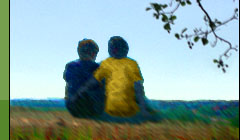
The challenge was to write a story inspired by this picture:

The picture is provided here under the doctrine of 'fair use' which is believed to apply. It is not the site's intent to infringe copyright. Copyright owners considering that this does not apply to their work should enter into dialogue with the webmaster by email [for their convenience they may use the submissions email address]. Items where copyright is asserted will either be taken down, or attribution made, at the copyright holder's choice.
Authors deserve your feedback. It's the only payment they get. If you go to the top of the page you will find the author's name. Click that and you can email the author easily.* Please take a few moments, if you liked the story, to say so.
[For those who use webmail, or whose regular email client opens when they want to use webmail instead: Please right click the author's name. A menu will open in which you can copy the email address (it goes directly to your clipboard without having the courtesy of mentioning that to you) to paste into your webmail system (Hotmail, Gmail, Yahoo etc). Each browser is subtly different, each Webmail system is different, or we'd give fuller instructions here. We trust you to know how to use your own system. Note: If the email address pastes or arrives with %40 in the middle, replace that weird set of characters with an @ sign.]
* Some browsers may require a right click instead