The Grand Tour in Italy
by Aramis
© 2026 Aramis all rigthts reserved
Summary
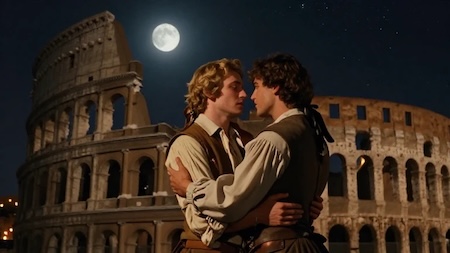
During the Grand Tour of Italy, the young English aristocrat Julian and his Florentine guide Antonio, both eighteen, develop a mutual attraction that transforms their professional relationship into a romantic one. In Rome, immersed among ancient ruins and Renaissance art, their intimacy grows until it culminates in a moonlit night at the Colosseum: abandoning themselves to the beauty of the place and each other's presence, they exchange caresses and kisses, experiencing a moment of passionate discovery that blends desire with artistic wonder.
Chapter 1: The Tradition of Travel
© 2026 Aramis all rigthts reserved
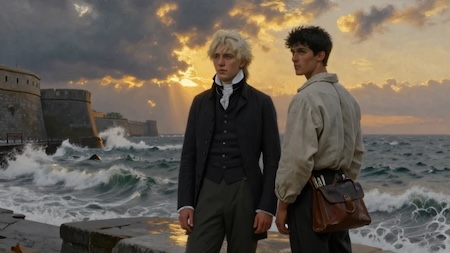
On that May afternoon, the sea off Genoa didn't seem to welcome a traveler, but rather to test him. The gray waves, driven by the west wind, crashed with a rhythmic consistency against the city walls, a sound that was new to Julian, different from the dull, controlled roar of the waves lapping the Cornish coast or the white cliffs of Kent. For an eighteen-year-old, accustomed to the rigidity of English rules and the predictability of country life, arriving in Italy represented the first tangible tear in the fabric of his orderly existence.
Julian adjusted the collar of his shirt, feeling the cool, expensive fabric rub against the skin of his neck. He was tall and slender, with a physique that betrayed years of athletic practice: cricket, swimming, and long horseback rides had sculpted his muscles with a resilience that contrasted with his apparent aristocratic delicacy. His hair, almost platinum blonde, was carefully cut but slightly rebelled against the Mediterranean humidity, framing a face with sharp features and intense blue eyes, which at that moment were scanning the city with a mixture of curiosity and awe. It wasn't the fear of danger, but the sacred fear one feels when faced with something immense and ancient, something his upbringing had described for years in books, but which now loomed before him, real and dusty.
The Grand Tour. Two words that weighed like millstones on his conscience and on the shoulders of his family. For generations, the sons of English aristocrats could not consider themselves complete men without undertaking this secular pilgrimage across continental Europe. It was a rite of passage, an educational necessity that occurred between adolescence and full adulthood. It was not simply tourism, nor leisure. It was a formative journey, designed to fill the gaps in a classical education that, though rigorous in the classrooms of Eton or Oxford, remained abstract and devoid of substance. The Grand Tour was meant to transform theoretical knowledge of Roman ruins and Renaissance paintings into lived experience. It was meant to teach taste, diplomacy, language, and above all, an understanding of Western civilization at its roots.
Julian had read everything about this trip. He'd studied the maps, memorized the mandatory stops: Turin, Milan, Venice, Florence, Rome, Naples. He knew the unwritten rules: dress appropriately, maintain a certain distance, observe without being too intrusive, collect souvenirs that were more than mere objects, but testimonies of a changed interiority. And yet, now that his feet were set on the cobblestones of Genoa, reality seemed to overwhelm theory. The air smelled of salt, spice, and something denser, more ancient. There was an orderly chaos in the streets, a hubbub that wasn't the controlled English he knew, but a music of open vowels and hard consonants that made him feel foreign, small.
He was standing on the porch of a modest but respectable hotel, chosen by his guardian in London to ensure security without excessive luxuries that might corrupt his spirit. Julian ran a hand through his hair, trying to calm his racing heart. He felt alone, despite the presence of the servants caring for his suitcases. His family was far away, across the Channel, and the weight of the responsibility of representing his house name in a foreign land was a burden he bore discreetly but firmly. He could not afford to make mistakes. He could not afford to appear clumsy or ignorant in the face of the greatness he was about to encounter.
It was in that moment of introspection that he saw the figure who would guide his steps arrive.
Antonio wasn't what Julian expected. He'd imagined an elderly guide, perhaps a retired professor, with a white beard and a walking stick, someone who spoke with the slowness of accumulated wisdom. Instead, the man who strode toward him with a determined stride was someone his own age. He, he would later learn, was also eighteen.
The physical difference between the two was immediate and marked. If Julian was the embodiment of Nordic aristocracy, tall, blond, and athletically built, Antonio was the epitome of Mediterranean vitality. At five feet seven inches tall, a stature that made him shorter than his client, yet his presence filled the space with a magnetic intensity. His hair was black, short, and slightly wavy, framing a face with fine yet expressive features. But it was his eyes that immediately captured attention: a deep green, almost emerald, that shone with a lively intelligence and a seemingly boundless curiosity. He wore simple but refined clothes, a light linen jacket and dark trousers, suited to moving through the streets and drawing, as evidenced by the leather bag he carried over his shoulder, filled with charcoal and notebooks.
Antonio was Florentine, born and raised between the hills of Fiesole and the streets of Florence. He had been chosen by a specialized agency in London, recommended for his profound knowledge of art, history, and, above all, his perfect command of the English language, acquired through university studies and frequenting the intellectual circles of the British capital during his formative years. But he was not just a walking encyclopedia. He was an artist. His hand was accustomed to capturing light, translating form into line, and understanding the soul of a work of art not only through the study of texts, but through the practice of creation.
"Mr. Julian?" Antonio's voice was warm, with a soft but precise Italian accent, free of the hesitations that often characterize those who speak a second language. He stopped a step away from him, bowing his head slightly in a gesture of formal respect. "I'm Antonio. Welcome to Genoa."
Julian nodded, returning the greeting with the polite stiffness he'd been taught. "Good morning, Mr. Antonio. I'm Julian. Thank you for coming."
Their handshake was brief, professional. Julian's long, tapered fingers clasped Antonio's shorter ones, with slightly calloused knuckles, a sign of manual as well as intellectual labor. It was a quick, purely functional contact, intended to seal the start of a contract. There was no human warmth in that touch, merely the confirmation of a business agreement.
"I've received instructions from your guardian," Antonio said, maintaining a detached but friendly tone. "Our itinerary is set: we'll leave tomorrow morning for Rome, passing through Tuscany. I've already verified reservations for inns and authorizations for access to archaeological sites. We're ready to begin our journey as soon as you've rested."
Julian felt relieved. The structure, the planning, were elements that reassured him. "Excellent. My education prepared me theoretically, but I confess that seeing all this live is... overwhelming. I need a guide who can not only point things out to me, but explain their meaning."
"That's exactly my job," Antonio replied, with a slight inclination of his head. "The Grand Tour isn't just a sightseeing tour. It's an immersion. We must study the works, yes, but also understand their historical, political, and social context. I will be your bridge between your culture and this land. However, I must be clear: our relationship will be professional. I am your guide, your interpreter, your advisor. You are the traveler, the disciple. Outside of our visiting hours, my responsibilities are limited to ensuring safety and compliance with agreements."
Antonio's words were spoken with crystal clarity. There was no ambiguity. He was defining the boundaries of their relationship from the very first moment. Julian nodded, implicitly accepting these conditions. It was what was expected. A young aristocrat could not afford to confuse himself with his guide. He had to maintain the distance, the social hierarchy his birth imposed. Antonio was a professional, an information craftsman, paid for his time and expertise. Nothing more.
"I understand perfectly," Julian said, trying to keep his tone detached. "I appreciate the clarity. My family expects me to return with an enriched mind, not with superficial friendships."
"Exactly," Antonio confirmed. "The Grand Tour is a solitary journey, even when there are two of you. Every traveler must come to terms with their own inner selves. I'll be there to provide you with the tools, but the transformation must take place within you."
They set off, heading to Julian's room to make sure everything was in order before dinner. As they walked down the hotel corridor, Julian observed Antonio in profile. There was a grace in his movements, a fluidity reminiscent of the statues he'd seen in English museums. Antonio walked with the confidence of someone who knows every stone in the street, every shadow in the alley. Julian, on the other hand, felt a little awkward, as if his English boots didn't know how to touch the Italian floor.
"Have you ever visited Italy before?" Julian asked, trying to break the silence without breaking the rules of professionalism.
"Only for short periods, to study," Antonio replied, without turning around. "But I know every corner of this peninsula. I know where to find the best light for drawings, I know the stories hidden behind every facade. I know Italy not as a tourist, but as a son. And you, Mr. Julian, what do you expect to find here?"
The question was direct, almost too direct for a first meeting, but Julian interpreted it as part of his guiding role: understanding the client's motivations in order to tailor the process. "I expect to see the grandeur of Rome," Julian replied, "to understand Renaissance art not as images on paper, but as reality. I expect to become a more complete man, more aware of the world."
"A noble goal," Antonio commented, pausing in front of the bedroom door. "Rome is a challenge. It is the city of ruins and resurrection. It requires an open mind and a receptive heart. Florence may be the prelude, but Rome is the beating heart. There, the past and the present merge violently and magnificently."
They entered the room. Julian sat on the chair by the window, gazing at the harbor stretching out below them. The sails of the boats fluttered like the wings of white birds. Antonio remained standing, checking the list of things to prepare for the next day.
"Tomorrow morning at eight," Antonio announced, consulting his notebook. "The train to Florence would be faster; the carriage ride through Liguria will be slower, but it will allow us to admire the coastal scenery. I've already arranged transportation. I advise you to rest well. Tomorrow the real work begins."
"Thank you, Antonio," Julian said, standing up. "I hope I don't disappoint you."
"Don't worry," Antonio replied, with a professional smile that didn't quite reach his eyes. "I have no personal expectations. I simply have a duty to do my job to the best of my ability. You are free to disappoint or exceed, as long as you do so intentionally. The Grand Tour is a journey of discovery, not perfection."
She left the room with a slight bow, leaving Julian alone with his thoughts.
Julian approached the window. The city of Genoa spread out below him, a labyrinth of red roofs and narrow alleys. He felt the weight of his position. He was a young aristocrat, rich, powerful, but at that moment he felt naked before the vast history and culture surrounding him. Antonio was the key to opening those doors, but he was also a wall. His professionalism was a barrier that protected them both. Julian knew he couldn't confide in him, he couldn't seek comfort in his presence. Antonio was a functionary, an intermediary.
Yet, there was something about Antonio's demeanor that intrigued him. His confidence, his passion for art, his ability to speak of beauty with such intensity. Julian wondered if, beneath that professional armor, there was something more. But he shook his head, pushing the thought away. This wasn't the time. The Grand Tour was a serious journey, an educational endeavor. Personal emotions were a luxury he couldn't afford, at least not yet.
He sat at his desk and opened the diary he had brought with him. They began writing the first lines, describing their arrival in Genoa, the view of the sea, and the meeting with the guide. He wrote carefully, choosing the right words, trying to capture the essence of the moment. "Today I met Antonio," he wrote. "A competent, professional, and distant guide. He is my bridge to Italy, but also my mirror. He shows me what I am: a naive young man, full of expectations, ready to learn. The journey has begun. The tradition of the Grand Tour awaits me."
He closed the diary and stood up. Tomorrow the real journey would begin. Towards Rome, towards art, towards self-discovery. But for now, there was only distance, formal respect, and the certainty that the relationship between him and Antonio would remain, for the time being, exclusively professional. No friendship, no intimacy, only the duty to learn and the duty to teach.
The sun was beginning to set, painting the sky with shades of orange and purple. Julian felt a little lonely, but also determined. The Grand Tour was an ancient tradition, a rite of passage that had shaped generations of men. Now it was his turn. And Antonio, with his knowledge and professionalism, would be his guide on this transformative journey. But only for as long as the journey lasted. Until the rules of the Grand Tour were broken, perhaps, by something unforeseen. But for now, everything was in order. Everything was professional.
Julian prepared for dinner, wearing his most formal attire. He had to look like a true aristocrat, like a young man who knew his place. Antonio would be waiting for him in the hall, ready to lead him toward the destiny that awaited him. And Julian was ready to follow him, step by step, respecting the boundaries that had been drawn.
The journey had begun. The tradition of the Grand Tour was alive and well. And Julian, with his young heart and open mind, was ready to discover what it meant to be a man in an ancient and complex world. But for now, there was only duty. Only respect. Only professionalism.
And so, as night fell on Genoa, Julian prepared to meet his guide again, knowing that their relationship would, for now, be only that of master and disciple, guide and traveler. Nothing more. Nothing less. Just the Grand Tour.
Chapter 2: The Light of Florence
© 2026 Aramis all rigthts reserved
Spring in Florence wasn't simply a season; it was an atmospheric event, a transformation of light itself that seemed to filter through the air with a different density than in England. As Julian's carriage passed through the city gates, the scent of jasmine and damp earth after the spring rains enveloped the two travelers like an invisible cloak. The slate and terracotta rooftops, illuminated by a sun lacking the harshness of the north, shone with a golden glow, while the dark cypress trees stood out against a sky so intensely blue it seemed hand-painted. For Julian, who had left behind the gray fog and short days, this explosion of life and color was almost dizzying. It was the first true test of the Grand Tour: not just seeing art, but breathing in the environment that had generated it.
The journey from Genoa had been long and silent, punctuated by the monotonous rhythm of the wheels on the cobblestones and the technical explanations of Antonio, who had maintained his role as guide with almost military precision. But as soon as we set foot in Florence, something in the air seemed to dissolve that initial rigidity. The city itself, with its history suspended between the Middle Ages and the Renaissance, seemed to demand a more fluid, more human approach.
The first stop was the Uffizi Gallery. Entering that endless corridor overlooking the Arno River was like crossing a threshold of time. Julian immediately felt small, not because of the grandeur of the building, but because of the concentration of human genius contained within. The walls were covered with canvases depicting myths, sacred stories, and portraits of powerful figures, but for Julian, at first, they were merely static images, objects of study to be analyzed with the cold mind he had been taught.
Antonio, however, didn't proceed like a mere encyclopedist. He stopped in front of one of Botticelli's works, Primavera, and didn't begin listing dates or mythological symbols. Instead, he turned his gaze to Julian, his green eyes catching the light filtering through the tall windows.
"Look, Julian," Antonio said, his voice lower than usual, almost a whisper mingling with the rustling of the visitors. "You don't just see flowers and goddesses. You see the desire for rebirth. Botticelli didn't just paint nature; he painted the beating of the human heart struggling to escape winter. Every gesture, every glance between the figures, is a silent dialogue that has continued for centuries."
Julian approached, following Antonio's gaze. For the first time, he didn't try to decipher the allegorical meaning, but let the image strike him directly. He saw the grace of the figures, the melancholy in Venus's gaze, the lightness of the wind blowing through the Hours' hair. And he saw Antonio. The young artist wasn't just explaining; he was feeling. There was a vibration in his posture, a tension in his hands that seemed to want to touch the canvas to feel the texture of the color. Julian realized that Antonio didn't see art as a dead object, but as a living presence, an extension of his own soul.
"It's as if..." Julian began, searching for words, "as if the artist had captured a moment of emotion that never ends. It's strange. In London, in museums, the works seem distant, protected behind the glass of history. Here they seem... breathing."
Antonio smiled, a smile that finally reached his eyes, transforming them into wells of light. "Because here, art isn't a memory, Julian. It's a living memory. Florence is made of this memory. Every stone, every brushstroke, is an attempt to say: 'I am here, I feel, I live.'"
That comment struck Julian deeply. It was a language that resonated with something hidden within him, a part of his personality that his strict upbringing had tried to stifle. For the first time, he felt not like an outside observer, but a participant. And Antonio's presence, who seemed to share this vision, created a subtle harmony between them, an invisible thread that began to bind them.
They continued their journey through the rooms, moving from Raphael to Leonardo. Each work became a pretext for a conversation that gradually moved away from pure erudition. Antonio spoke with a passion that was contagious, using metaphors that blended art with everyday life, love, and loss. Julian listened, captivated not only by the words, but by the way Antonio pronounced them, with a musical cadence that seemed to match the rhythm of his heart.
In the afternoon, they visited the Accademia Gallery to see Michelangelo's David. The impact was different. If the Uffizi was a dialogue, the Accademia was a powerful monologue. The marble giant, naked and perfect, dominated the room with an almost oppressive physical presence. Julian stopped to gaze, feeling the grandeur of the figure towering over him.
"It's human perfection," Antonio murmured, positioning himself beside him. "But it's not the perfection of a statue. It's the perfection of tension. Look at the veins, the concentration in the eyes. Michelangelo didn't sculpt a god, he sculpted man at the moment of choice, before action. It's the strength that lies in vulnerability."
Julian looked at the David, then at Antonio. In that moment, the resemblance between the work and the young artist was evident. Antonio, too, possessed that tension, that strength contained within a young, lean body. His passion for beauty, his ability to see beyond the surface, made him, in turn, a living work of art. Julian felt a heat rise up his neck, a sense of embarrassment he couldn't explain. He looked away, staring at the marble floor, but the feeling of being observed by Antonio, with his intense, penetrating attention, never left him.
"You see a lot," Julian said, trying to break the silence that had fallen between them. "More than I can see."
"Because I've learned to listen," Antonio replied, turning to him. "And because beauty isn't just in the eyes, Julian. It's in how you receive it. You have a way of looking at things that is... rare. As if you were searching for something you don't yet know you want to find."
Antonio's words were charged with a meaning that went beyond simple artistic observation. There was a depth to those words that made Julian tremble slightly. He felt exposed, as if Antonio had read something hidden in his soul. But instead of feeling threatened, he felt a strange sense of relief. Someone truly saw him, not as an English aristocrat, but as a person.
The day at the Uffizi and the Accademia ended with sunset. The sun began to set behind the hills of Fiesole, painting the sky with shades of orange and pink that reflected on the waters of the Arno River. The city was preparing for nightfall, but the air was still warm, scented with flowers and life.
"We should rest," Antonio suggested, glancing at his watch. "We have a busy schedule tomorrow."
"Wait," Julian said suddenly. "I'd like to take a walk. Along the river. I want to see the city at sunset."
Antonio hesitated for a moment. The rules of the Grand Tour required maintaining a certain pace, not wasting time on unplanned activities. But there was something in Julian's tone, in his request—not an order but an invitation—that made him change his mind.
"All right," he said, smiling. "A stroll along the Arno. It's the perfect way to end the day."
They left the Academy and headed toward the river. The street was lined with blossoming trees, their petals falling delicately onto the pavement. The noise of the city faded, giving way to the sound of rushing water and the song of birds preparing for the night. They walked side by side, but not too close, maintaining the professional distance they had established in Genoa. And yet, the air between them had changed. It was no longer empty, but charged with a silent tension, a mutual awareness that could not be ignored.
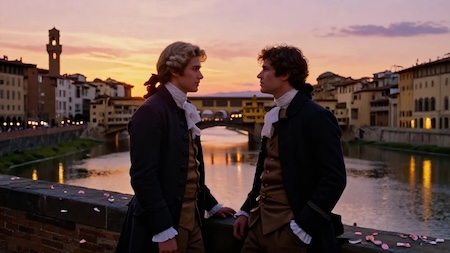
They reached the Ponte Vecchio, the medieval bridge lined with shops overlooking the river. The shop windows lit up, casting a golden reflection on the dark water. Julian stopped to gaze at the view, his heart pounding in his chest. The beauty of Florence, in that moment, was overwhelming. And Antonio's presence beside him made it all the more intense.
"It's incredible," Julian said, without turning around. "I didn't think a city could be so alive. It's as if every stone had a story to tell."
"Florence is made of stories," Antonio replied, his voice close, almost a breath. "But the most important stories are those that haven't been written yet. The ones we're living right now."
Julian turned slowly. They found themselves face to face, separated by just a few inches. Antonio's green eyes stared at him with an intensity that made him tremble. In that moment, the social barriers they had built in Genoa seemed to crumble. Gone were the young aristocrat and his guide. There were only two young men, both eighteen, both searching for something they couldn't define.
Julian admired Antonio's passion for beauty, his ability to see the world through fresh eyes. And Antonio, in turn, was fascinated by the young Englishman's naiveté and nobility of spirit, by his ability to fearlessly let himself be carried away by emotion.
"Antonio," Julian whispered, his voice breaking with emotion. "Thank you. For showing me all this."
"You're welcome," Antonio replied, with a smile sweeter than anything Julian had ever seen. "It's a pleasure to share beauty with someone who knows how to see it."
They looked at each other for a moment longer, a moment that seemed to last an eternity. Then, as if they'd reached a limit they couldn't cross, they moved away slightly, regaining their distance. But something had changed. That subtle recognition of mutual attraction had emerged, like a sprout breaking through the earth. It wasn't love yet, it wasn't a declaration yet. It was only a shadow, a harbinger of what might be. But it was there, palpable, in the spring air of Florence.
They continued walking, heading back to the hotel. The silence between them was no longer heavy, but comfortable. They both knew the journey had changed. It was no longer just an educational journey. It had become something deeper, something that would bind them forever. And as night fell over Florence, illuminating the domes and bell towers with moonlight, Julian and Antonio knew their Grand Tour had just begun its true adventure.
The Florentine spring had welcomed them with its golden light, and in that light, they had found something they weren't looking for, but needed to find. An attraction born of beauty, of sharing, of mutual discovery. And even if for now it was only a whisper, they knew it would soon become a strong voice, guiding their steps toward Rome, toward the destiny that awaited them.
But for now, there was only the walk, the flowing river, and the certainty that their relationship, though still professional, was beginning to evolve into something more. Something intimate, secret, forbidden. And in that moment, under the light of the Florentine spring, anything seemed possible.
Chapter 3: The Shadows and Lights of Rome
© 2026 Aramis all rigthts reserved
Arriving in Rome wasn't an entrance, but an immersion. If Florence had been a harmonious symphony, Rome was a cry of stone and history, a place where the past wasn't preserved in glass cases, but lived, breathed, and sometimes violently pressed against the present. The air of the Eternal City was thick, laden with ancient dust, incense wafting from the churches, and heat rising from the cobblestones, creating an almost feverish atmosphere. For Julian, who came from the geometric order and controlled fog of England, Rome was an assault on the senses. Every corner concealed a ruin, every façade concealed a secret, and the grandeur of the place seemed to call into question its very existence.
As they moved through the Roman Forum, among the broken columns silhouetted against a blindingly blue sky, Julian felt for the first time the crushing weight of his loneliness. In London, his aristocratic status was a given, a privilege that isolated him yet protected him. Here, amid the ruins of a fallen empire, his nobility seemed insignificant. Who was he, Julian, compared to the greatness of Caesar or Augustus? He was just a young boy, a tourist in a theater of giants. The rigidity of English conventions, which had always guided him, made him feel like a stranger in a world where the rules were different, where life flowed with a fluidity that both frightened and fascinated him.
Antonio, on the other hand, seemed at home. He walked among the ruins with the ease of one who knows every stone, every shadow. For him, those ruins were not signs of decay, but witnesses to a vital continuity. His Mediterranean nature, open and expressive, blended with the landscape. There was no distance between him and history; he was part of it.
"Look, Julian," Antonio said, pointing to a partially collapsed column. "You don't just see a ruin. You see the strength that built this place and the fragility that destroyed it. It's the same balance that exists in life. Our English culture tends to see time as a straight line, a constant progression. Here, time is a circle. Everything returns, everything transforms, nothing truly dies."
Julian listened, fascinated by the prospect. "It's a liberating thought," he admitted, "but also frightening. In our country, if you make a mistake, you have to fix it, hide it, correct it. Here, it seems that error is part of the beauty. Ruins are beautiful precisely because they are imperfect."
"Exactly," Antonio replied, turning to him with a smile that revealed a profound understanding. "England is the land of formal perfection, of rules, of control. Italy is the land of expression, of emotion, of creative chaos. You grew up in the former, I in the latter. Perhaps that's why we're attracted to each other."
The word "attraction" had fallen into the air like a stone in a pond, creating invisible circles that widened between them. It hadn't been said with malice, but with disarming sincerity. Julian felt a shiver run through him. It was true. Their relationship was changing. It was no longer just a matter of guide and traveler. It had become an exchange of souls, a confrontation between two ways of being in the world.
The conversations, during visits to the Vatican and the basilicas, became increasingly intimate and philosophical. They no longer spoke only of art, but of life, desires, fears. Julian, who usually maintained a formal detachment, began to confide in him. He spoke of how he felt suffocated by his family's expectations, how his social position was a gilded cage that prevented him from being himself. Antonio listened attentively, without judgment, offering comfort not with words, but with his presence.
"You're not just an aristocrat, Julian," he said one evening, as they sat on a bench in the Palazzo Barberini garden. "You're a man who seeks the truth. And truth isn't found in rules, but in the heart. Italy is teaching you this. It's opening the doors that your upbringing closed."
Julian looked at him, feeling a warmth that wasn't just that of the sun. "And you, Antonio? What are you looking for?"
"I seek beauty," Antonio replied, his voice almost a whisper. "But not superficial beauty. The kind that hurts, that changes you. The beauty born from suffering, from passion, from freedom. And now, I'm finding this beauty in her."
Antonio's words were like a spark that lit a hidden flame in Julian. He felt exposed, vulnerable, but also free. For the first time, he didn't have to hide his feelings, he didn't have to pretend to be someone else. He could be himself, with all his contradictions, his fears, his desires.
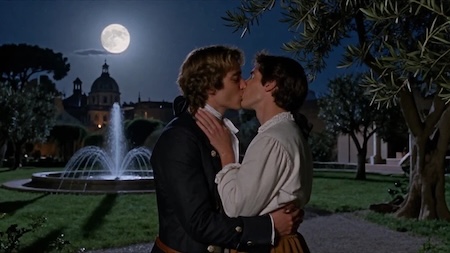
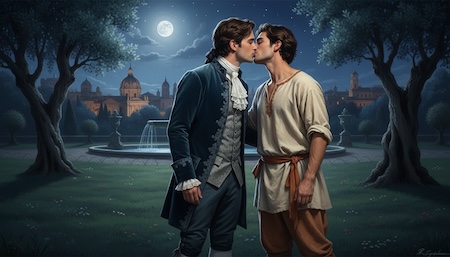
One evening, they decided to visit the Villa Borghese Gardens. It was sunset, and the sunlight was fading, painting the sky with shades of purple and orange that reflected on the leaves of the trees. The gardens were almost deserted, an oasis of peace in the chaotic heart of the city. They walked slowly, aimlessly, guided by the rhythm of their breathing and the sound of their footsteps on the grass.
The contrast between their personalities had become the center of attraction. Julian, with his English rigidity, his tendency to control every emotion, was fascinated by Antonio's fluidity, his ability to let go, to live in the moment without fear. Antonio, with his Mediterranean openness, his passion for life, was fascinated by Julian's depth, his nobility of spirit, his ability to feel even when he tried to hide his emotions.
They stopped near a fountain, where the water gushed with a gentle sound. The sun had already disappeared, and the moon was beginning to emerge, illuminating the faces of the two young people with a silvery light.
"Julian," Antonio said, his voice cracking with an emotion he could no longer hide. "I know the rules of the Grand Tour tell us to keep our distance. I know society tells us not to mix our lives. But I can't do that anymore. I can't look at your artwork without thinking of you. I can't walk through these gardens without feeling your presence as a part of me."
Julian looked at him, his heart pounding. He felt the same, but the fear of breaking the rules, of losing control, held him back. "Antonio," he whispered, "we don't know what we're doing. We're just two kids. We're different. The world won't accept us."
"The world doesn't matter," Antonio replied, taking a step toward him. "There's only this moment. There's only us. And the beauty we found together. There's no point in hiding it."
They moved closer, until their foreheads touched. There were no words, no explanations. There was only the emotional vulnerability they shared, the desire to get closer that could no longer be contained. Julian closed his eyes, feeling the warmth of Antonio's breath on his face. Antonio closed his eyes, feeling Julian's hand gently rest on his shoulder.
In that moment, social barriers, cultural differences, and societal norms all vanished. Only two young men remained, united by an attraction born of beauty, sharing, and mutual discovery. It wasn't a declared love, it wasn't a promise of a future. It was simply a moment of truth, a moment of purity in a complex and confusing world.
They kissed, slowly, with a sweetness more powerful than any wild passion. It was a kiss that said everything without words: "I see you, I understand you, I love you." It was a kiss born of vulnerability, fear, hope.
When they parted, they looked into each other's eyes, trying to read in their faces what their hearts could not express. Julian felt a peace he had never felt before. Antonio felt a joy that filled him with life.
"It doesn't matter what happens tomorrow," Julian said, his voice steady. "This moment is real. We are real."
"Yes," Antonio replied, smiling. "And that's all that matters."
They slowly walked away, returning toward the gardens' exit, but their connection had changed forever. They were no longer just guide and traveler. They were two souls who had found each other, two hearts that had recognized each other's beat. And as night fell over Rome, illuminating the ruins and churches with moonlight, Julian and Antonio knew their journey had just reached its turning point.
The contrast between their personalities was no longer an obstacle, but the source of their attraction. Julian's rigidity and Antonio's fluidity had merged, creating a perfect balance. And in that balance, they had found the freedom to be themselves, to love without fear, to live without limits.
Rome, the Eternal City, had witnessed their encounter. Its shadows and lights had illuminated their story, making it unforgettable. And as they walked toward the hotel, under the starry sky, they knew that their Grand Tour would not be merely a geographical journey. It would be an inner journey, a journey of self-discovery and of others.
And on that journey, there was no longer room for rules, conventions, or fears. There was only love, beauty, freedom. And that was all that mattered.
Chapter 4: The Heat of the Stones
© 2026 Aramis all rigthts reserved
The morning light in Rome wasn't as gentle as London's. It didn't filter softly through the heavy curtains, but rather cut sharply through the cracks in the shutters, drawing golden lines on the dust that danced in the still air. Julian woke with a start, his heart pounding against his ribs, as if he'd run a marathon in his sleep.
For a moment, disoriented, he tried to remember where he was. Then, the memory hit him like a wave: Villa Borghese, the purple twilight, the warmth of Antonio's lips, the taste of wine and freedom. He brought a hand to his mouth, his fingers trembling slightly as they brushed his lips. Were those footprints still there? Or was it just the echo of a dream that his mind, accustomed to rationality, refused to accept as reality?
He stood up, his legs still a little unsteady, and approached the window. Rome spread out below him, a sea of terracotta and stone, noisy and chaotic even that hour. But today, for the first time, the chaos didn't frighten him. It seemed to vibrate on a different frequency, a resonance that resonated within him, in sync with the rapid beating of his heart.
When he descended into the breakfast room, the air was thick with the smells of roasted coffee, warm bread, citrus fruits. Antonio was already there, sitting at their usual table, intent on reading a newspaper. At the sound of Julian's footsteps, he looked up. There was no formal greeting, nor the polite smile of the day before. His dark eyes fixed on Julian with an intensity that took the Englishman's breath away. There was a silent question in that gaze, a promise, and a challenge.
"Good morning, Julian," Antonio said, his voice lower than usual, a whisper that seemed to belong to a private world. "Did you sleep well?"
"Yes... yes, thank you," Julian replied, sitting down with a composure that felt false, almost theatrical. His hands trembled slightly as he picked up the cup. Antonio watched him, one corner of his mouth curving into an enigmatic smile. He didn't say anything, but the way he passed him the sugar bowl, their fingers brushing for a moment too long, sent an electric shock up Julian's arm, nearly making him drop the cup.
The silence that followed wasn't empty. It was charged with everything they couldn't say, everything they had begun to do. Every gesture, every movement, had become an act of intimacy. Julian felt the heat of Antonio's body across the table, as if the physical distance had been erased by an invisible thread that bound them.
"Today," Antonio said, putting down the newspaper and tilting his head, "we want to visit the Capitoline Museums. I heard there's a statue of Bacchus that... well, that might particularly interest you."
Julian looked at him, confused. "Bacchus? The god of wine?"
"Exactly," Antonio laughed, a mischievous glint in his eyes. "The god of abandonment, madness, loss of control. I think you need to get to know him better."
Julian felt a shiver run down his spine. This wasn't just a tourist visit. It was an invitation. And for the first time, he wasn't about to refuse.
In the Capitoline Museums, the air was fresh and scented of wax and ancient stone. The rooms were crowded with tourists, but Julian and Antonio seemed isolated in a private bubble. As they gazed at the statues, the dialogue flowed between art and desire, each word laden with double meanings that only the two of them could decipher.
"Look," said Antonio, pointing to a statue of Bacchus, the god with the youthful face and wine-dimmed eyes, surrounded by grape vines. "Do you see how the marble seems alive? As if the blood still flows beneath that cold surface? It's the beauty born of passion, Julian. From the ability to let go."
Julian stared at the statue, but his mind was elsewhere. He felt Antonio's gaze on him, warm and penetrating. "It's... impressive," he murmured, his voice cracking slightly. "But it's only stone, Antonio. It can't hear."
"Maybe," Antonio replied, leaning closer until their shoulders touched. "But we do. And right now, I feel everything."
Their hands accidentally touched as they pointed out a detail on the statue's base. The contact was brief, but it was enough to make Julian jump. The heat of Antonio's skin through his leather gloves was a shock that traveled up his arm, lighting a fire in his lower abdomen. He turned to Antonio, his eyes wide, his breathing shallow.
"We have to... we have to go," she whispered, trying to regain control. "There's more to see."
"Sure," Antonio nodded, but didn't move away. "Let's go. But you know, Julian, sometimes rules are just chains that keep us from seeing true beauty."
They left the museums and headed toward the Janiculum, seeking some peace and quiet. The sun was setting, painting the sky a deep orange that blended with the purple of dusk. Rome stretched out at their feet, an endless mosaic of rooftops and domes, but Julian couldn't see the city. He saw only Antonio's profile, illuminated by the fading light, his features sculpted like those of an ancient statue, yet alive, warm, breathing.
They were in a secluded corner of the park, away from the tourists, where the olive trees cast long, irregular shadows on the grass. The wind had died down, leaving an almost sacred silence, broken only by the rustling of the leaves and the sound of their breathing.
"Julian," Antonio murmured, stepping forward. His voice was broken, filled with an emotion he could no longer contain. "We can't pretend anymore. Not here, not now."
Julian opened his mouth to reply, to search for an excuse, a logical reason to stop, but the words died on his tongue. Antonio's body was so close that he could feel the heat emanating from it, a heat that seemed to penetrate through his clothes, igniting every fiber of his being.
"Antonio..." she whispered, her voice barely audible. "We're... we're in a public place. Someone might see us."
"What does it matter?" Antonio replied, taking one last step until their bodies touched. "The world out there doesn't exist. Only this exists. Only you exist."
Antonio's hands rested on Julian's shoulders, fingers tangling in the fabric of his jacket, gripping with a strength that was both protective and possessive. Julian closed his eyes, letting the contact wash over him. For years he had lived in a cage of rules, conventions, fears. And now, in that moment, those chains were breaking.
"I've never done this," Julian admitted, his voice shaking. "I don't know what to do."
"Let me guide you," Antonio whispered, leaning his face close to hers. "Feel me. Feel me."
Antonio's lips landed on his, not with the sweetness of a first kiss, but with a growing hunger, a desire that could no longer be contained. Julian responded with a passion he didn't know he possessed, his hands gripping the young man's shoulders, pulling him closer, as if he wanted to merge with him.
The world around them faded. There were no more rules, no more fears. There was only the warmth of their skin, the taste of wine on their lips, the rhythm of their breathing synchronizing. Julian felt Antonio's hands slide down his back, pressing against him, making him feel alive, real, desired.
"Julian," Antonio moaned, breaking away for a moment to look into his eyes. "You're so beautiful. So real."
Julian didn't reply. There were no words to describe what he was feeling. He simply held Antonio tighter, letting himself go completely, allowing that embrace to become something more, something intimate, forbidden, wonderful.
Chapter 5: The Silence of Naples and the Return

© 2026 Aramis all rigthts reserved
The carriage carrying them from Rome to Naples advanced along the coastal road like a black insect on a silver thread. Julian gazed out the window, the landscape rushing by: olive groves, vineyards, the sea shimmering in the midday sun. But her mind was elsewhere. She had remained in the room of the Roman inn, nestled between tangled sheets and the warmth of Antonio's body.
Three days had passed since that night. Three days of complicated silence, of glances that met and fled, of hands that brushed without the courage to hold. The kiss on the Janiculum had been a beginning, but the night at the inn had been a revelation. And now, what?
"Naples," Antonio announced, breaking the silence that had lasted for hours. His voice was normal, too normal. "We'll be there soon."
Julian nodded without turning around. "Yes. Thank you."
"Julian," Antonio said more softly. "Can I talk to you?"
Julian turned slowly. Antonio was looking at him with an expression he couldn't quite decipher: concern? Desire? Fear? "Of course."
"I know it's weird," Antonio began, choosing his words carefully. "I know it's not... easy. But I want you to know that I don't care where we're going. I only care where we're going together."
Julian felt a lump in his throat. "Antonio, I..."
"Don't say anything," Antonio interrupted, placing a hand on his. "I know what you're thinking. I know what you're afraid of. But I don't want you to make decisions based on fear. Make them based on what you feel."
Julian closed his eyes. What did he feel? He felt the warmth of Antonio's hand on his. He felt the weight of the past dragging him back. He felt the future opening up before him, bright and terrifying.
"I know," she whispered. "I know."
Naples was a scream. Rome had been contemplation, Naples was pure life, chaotic, noisy. The streets were filled with vendors, children playing, the smells of fish, spices, and fried food. Julian felt overwhelmed, but Antonio walked at his side, confident, as if he were the guide to a world Julian didn't know.
"This is the market," Antonio said, pointing to a crowded square. "Everything is sold here. Fish, fruit, clothes, secrets."
Julian laughed, a laugh that sounded strange to himself. "Secrets?"
"Yes," Antonio laughed. "Everyone has something to hide. Here, at least, you can hide it in a crowd."
They stopped at a small tavern for lunch. The place was dark, smelling of wine and garlic. They sat at a narrow table, their knees touching under the tablecloth. Julian felt the warmth of Antonio's body, and every touch was a reminder of what they had shared.
"After lunch," Antonio said, "I want to take you to see Vesuvius."
Julian looked at him, surprised. "The volcano?"
"Yes. It's dangerous. But it's also beautiful. Like us."
Julian nodded, not fully understanding the meaning of those words. But he didn't ask for explanations.
Vesuvius loomed menacingly on the horizon, a mountain that seemed to breathe. They ascended slowly, the path winding through ash and volcanic rock. The air was hot, dry, and thick with sulfur.
"Here," Antonio said, stopping at a vantage point. "From here you can see everything. Naples, the gulf, the sea."
Julian approached the edge, looking down. The city was a mosaic of rooftops and chimneys, the sea shimmering like glass. But he didn't see beauty. He saw fragility. Everything could be destroyed in an instant.
"Julian," Antonio said, standing behind him. His hands rested on Julian's hips, pulling him toward him. "Don't look down. Look at me."
Julian turned and found himself face to face with Antonio. His face was close, too close. His breathing was mixed, hot and labored.
"I don't know how much time we have," Julian said, his voice breaking. "I don't know what will happen when the journey ends."
"It doesn't matter," Antonio replied. "What matters is now. It's this moment. It's us."
Antonio's lips landed on his, and Julian let go, as he had learned to do. The kiss was different from the previous ones: more urgent, more desperate. As if they both knew it was the last.
"Take me inside," Julian whispered, his voice barely audible. "Take me into your room."
The inn in Naples was larger than the one in Rome, but the room was similar: a four-poster bed, a window overlooking an alley, the smell of lavender and wood. But there was a difference. This time, Julian wasn't nervous. He was determined.
They closed the door and looked at each other. There were no words. They weren't necessary.
Antonio approached first, his hands resting on the collar of Julian's jacket. He slowly removed it, as he had in Rome, but this time Julian helped him, his hands moving with new confidence. The shirt followed, then the pants, then everything.
Julian felt naked, but he wasn't afraid. For the first time in his life, he felt free. Naked not only of clothes, but of masks, conventions, fears.
"You're so beautiful," Antonio murmured, caressing his face with his fingers. "So perfect."
"I'm not perfect," Julian replied, his voice low. "I'm just... myself."
"And that's exactly what I want," Antonio said, kissing him again.
They fell onto the bed, their bodies entwining, their hands seeking each other. Julian felt Antonio's hands slide along his body, exploring every curve, every line. Every touch was a question, every answer a yes.
"Julian," Antonio whispered, his mouth touching his ear. "Do you want me to touch you? Here?"
Antonio's fingers slid down his abdomen, reaching what Julian had hidden for years. Julian gasped, his body tensing, then relaxing completely.
"Yes," he said, his voice breaking. "Yes, I want to."
Antonio caressed him delicately, his fingers moving with a precision that made Julian moan. The pleasure was intense, almost painful. Julian closed his eyes, letting his body guide him, as Antonio had taught him.
"Do you like it?" Antonio asked, his voice a hoarse whisper.
"Yes," Julian panted. "Yes, I like it. You make me feel... alive."
"And I want to make you feel alive," Antonio replied, kissing his neck, his jaw, his lips. "I want to make you forget everything else. Just us. Just this."
Julian let himself go completely, abandoning all resistance. Antonio's hands slid beneath him, exploring every part of his body, making him feel desired, loved, accepted.
"Now," Antonio said, his voice low and firm. "Now I want to give you everything."
Julian nodded, his heart pounding in his chest. There was no fear left, only desire. Pure, burning, uncontainable desire.
Antonio positioned himself on top of him, his legs opening to welcome him. Julian felt the warmth of Antonio's body, his weight, his presence. It was real. It was true.
"Are you ready?" Antonio asked, his voice shaking slightly.
"Yes," Julian whispered. "I'm ready."
Antonio's lips touched his, and Julian let go, completely. The world faded away. There were no more rules, no more fears. There was only love, beauty, freedom.
As she entered him, Julian moaned, his body tensing, then relaxing. The pain was there, but it was overcome by pleasure, intimacy, connection.
"Julian," Antonio moaned, his voice cracking with emotion. "You're so beautiful. So real."
Julian didn't reply. There were no words to describe what he was feeling. He simply held him tighter, let go completely, allowed that embrace to become something more, something intimate, forbidden, wonderful.
They moved together, their rhythms synchronizing, their breathing mingling. Julian felt Antonio's body against his, the warmth, the weight, the presence. It was real. It was true.
"Julian," Antonio groaned, his voice cracking. "Julian, I'm..."
Julian held him tighter, his hands gripping his back, pulling him closer. "Don't stop. Never stop."
"I won't stop," Antonio promised, and then the world faded away.
After the rush of pleasure, they lay side by side, their breathing gradually calming. Sweat connected their foreheads, their bodies still bound by residual tension. Julian gazed at the ceiling, the shadows dancing on the dark surface. He felt Antonio's body relaxing against his, heavy and warm.
But Julian didn't want it to end like this. He didn't want to be the only one receiving. He didn't want to be the passive one waiting for grace. He had broken the chains in Rome, but in Naples he had to learn to give.
He slowly pulled away from Antonio, rolling him onto his side. The boy looked at him, confused, his eyes still glazed over with pleasure. "Julian? What are you doing?"
Julian didn't respond immediately. He sat up, his legs sliding off the bed until his knees touched the floor. He knelt between Antonio's legs, gazing at the naked body of his now lover, the light from the window caressing his skin, highlighting every muscle, every curve.
"You taught me to feel," Julian said, his voice low but firm, without hesitation. "Now I want to teach you to receive."
Antonio opened his mouth to object, to say it wasn't necessary, but Julian silently placed a hand over his mouth. "No. Let me do it."
He leaned forward. The first contact was a light touch, his lips brushing the still-wet tip. Antonio held his breath, a strangled moan escaping his throat. Julian felt the heat, the salty taste of his skin, the arousal pulsing beneath his mouth.
It was no longer fear that drove him, but a burning curiosity, a desire to explore the other to the fullest. Julian opened his mouth and enveloped Antonio, his tongue moving with deliberate slowness, learning the rhythm, the pressure, the taste.
"Julian..." Antonio moaned, his hands clutching his love's hair, tugging lightly, not to command, but to feel him closer. "God, Julian... I didn't know..."
Julian looked up, his eyes shining with a new light. There was a challenge in that look, a silent question: Can I? And the answer was in the way Antonio's body tensed, in the way his breathing became labored.
Julian continued, plunging deeper, using his tongue to explore every nook and cranny, feeling Antonio's contractions, the way his body reacted to his touch. It was no longer an act of submission, but of power. Julian controlled the rhythm, the tempo, the intensity. He felt Antonio's pleasure growing, and that pleasure was his own.
"Julian, I'm going to..." Antonio gasped, his voice breaking. "Julian, I can't..."
"Let go," Julian whispered, his voice vibrating against his skin. "Let go to me."
Antonio moaned loudly, his body tensing, then relaxing completely as pleasure overwhelmed him. Julian held him tightly, continuing his movement, feeling every spasm, every contraction, until Antonio collapsed on the bed, breathing heavily, his eyes closed.
Julian stood up slowly, wiping his mouth with the back of his hand. He felt different. Stronger. More real. He had taken what he wanted, he had given what he felt. He was no longer the fearful young Englishman. He was Julian, the man who loved, who desired, who acted.
He lay down again next to his boyfriend, who was looking at him with a look of amazement and admiration. "You're incredible," Antonio whispered, his voice still cracking. "I didn't know you could... that you wanted to."
Julian smiled, a genuine, free smile. "I've learned," he said. "I've learned that I mustn't just receive. I must also give. I must be free."
Antonio hugged him, holding him tightly, as if he wanted to hold him forever. "You're free," he whispered against his ear. "You're free, Julian. And I'm with you."
Afterward, they lay next to each other, their breathing gradually calming. Julian stared at the ceiling, the shadows dancing on the dark surface.
"Julian," Antonio said, his voice low. "Tomorrow... tomorrow we have to decide."
Julian closed his eyes. He knew it. He'd known it since they'd begun this journey. But now that the moment had come, he wasn't ready.
"I know," she whispered. "I know."
"I don't want to lose you," Antonio said, his voice shaking. "I don't want it to end like this."
"I don't know what to do," Julian replied, his voice breaking. "I don't know what to choose."
"Then choose what you feel," Antonio said, taking his hand. "Not what you think. What you feel."
Julian nodded, speechless. There were no words. Only silence, and his heart pounding in his chest.
The night had just begun in Naples, and for Julian and Antonio, the journey was entering its most difficult, most painful, most real phase. Outside, the city continued to live, but inside that room, time had stopped, suspended in an embrace that promised an uncertain future together.
Chapter 6: The Port of Farewell
© 2026 Aramis all rigthts reserved
The morning light in Naples wasn't the golden, welcoming light of previous nights. It was gray, cold, sharp as a steel blade. The sky was covered by a blanket of low clouds that seemed to be hiding the city, as if even the sky knew a farewell was about to take place.
Julian dressed carefully, every movement mechanical, almost painful. He donned his dark jacket, his tight tie, his impeccable trousers. Each piece of clothing was a brick that rebuilt his old armor, the armor of the respectable Englishman, the devoted son, the man of the world. But beneath the fabric, his skin still burned with the memory of Antonio's touch.
The room was tidy. The bags were closed, the dark leather suitcases packed and ready to go. Gone was the mess of the previous nights, the tangled sheets, the scattered clothes. There was only silence, heavy and absolute.
Antonio sat on the edge of the bed, still naked, his skin pale in the gray light from the window. He watched Julian button his jacket, his face impassive, but his dark eyes betraying a deep pain.
"It's time," Julian said, his voice hoarse. He didn't look at Antonio. He didn't dare.
"Yes," Antonio replied. "It's time."
Julian picked up the suitcase, the handle cold under his hand. He finally turned to Antonio. Their eyes met, and for a moment the world stopped. There were no words. They weren't needed. That look contained everything: gratitude for what had been, pain for what would end, love that could never be spoken aloud.
"Thank you," Julian whispered. "For everything."
Antonio slowly stood up and approached. He hugged him, holding him tightly, as if he wanted to imprint his form on Julian's body, as if he could transfer part of his soul to him. Julian closed his eyes, letting Antonio's warmth envelop him one last time.
"Don't forget me," Antonio murmured against his ear.
"Never," Julian replied, his voice breaking. "Never."
They separated. Julian picked up his suitcase and left the room, without looking back. He couldn't. If he'd looked back, he wouldn't have been able to leave.
The carriage awaited them. The ride to the port was short, but every second felt like an eternity. Julian gazed out the window, watching the streets of Naples rush by. The houses, the markets, life continuing, indifferent to their grief.
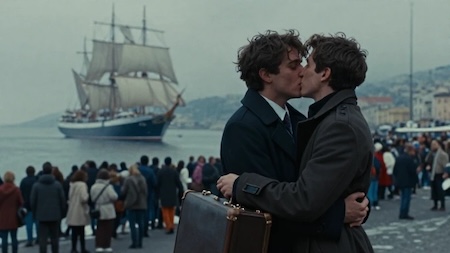
At the port, the air was thick with salt and smoke. The ships rocked on the waves, their sails billowing in the wind. The crowd was noisy, chaotic, vibrant. But Julian and Antonio seemed isolated in a bubble of silence.
"There," Julian said, pointing to the ship. "I have to go."
Antonio nodded, silently. His hands were shaking slightly.
Julian took a step, then stopped. He turned toward Antonio, and for a moment, the crowd seemed to vanish. There was only the two of them. They leaned closer and kissed. It wasn't a kiss like the ones of the past nights, full of desire and passion. It was a farewell kiss, sweet and painful, smelling of unshed tears and salty sea air.
"Goodbye, Julian," Antonio whispered, pulling away.
"Goodbye, Antonio," Julian replied.
He boarded the ship, his heavy suitcase in his hands. He turned one last time, searching for his love among the crowd on the dock. He saw him, still, like a stone statue. He didn't move, he didn't move away. He remained there, watching him, until the ship pulled away.
Julian leaned against the railing, his heart pounding. The Italian coast receded, becoming a dark streak on the horizon. Then, it too vanished, swallowed up by the fog and the sea.
Julian closed his eyes. There was no more fear. There was only the certainty that nothing would ever be the same again. He had lost a love, but he had found himself. And this, perhaps, was the true price of the Grand Tour.
Epilogue: The Legacy
© 2026 Aramis all rigthts reserved
Ten years later.
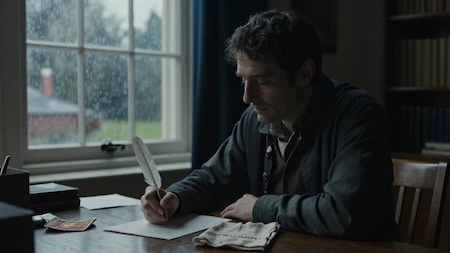
England was gray, as always. The rain beat against the windows of Julian's study, a steady, monotonous rhythm that accompanied his thoughts. Julian sat at his desk, pen in hand, intent on writing. He no longer wrote business letters or family reports. He wrote.
On the desk, next to the papers, lay a small object: a time-worn linen handkerchief with a small Italian embroidery Julian had learned to recognize with his eyes closed. He touched it often, like a talisman, a reminder of what had once been.
Julian was no longer the rigid and fearful man who had set out on the Grand Tour. He had changed. His gaze was deeper, less judgmental. He had learned to see beauty in simple things, in life, in love. He had learned to feel.
He had never seen Antonio again. There had been no letters, no meetings. But Julian knew that Antonio was alive, living his life in Naples, under the hot sun, among the noisy streets. And Julian knew that, somewhere, Antonio was thinking of him.
The real Grand Tour, Julian understood, hadn't been the tour of Italy. It hadn't been visiting ancient ruins, cities of art, museums. The real Grand Tour had been the inner journey he and Antonio had taken. It had been the journey toward their own humanity, toward their own truth.
They had discovered that love has no boundaries, that desire has no rules, that freedom is a choice made every day. And even though their love was over, the legacy they had left in each other was eternal.
Julian put down his pen and looked out the window. The rain continued to fall, but for the first time, it didn't scare him. He knew that somewhere in the world there was a warm sun, a blue sea, and a man who loved him.
And that was enough.
I would love to hear your thoughts on this new story via email (adamello2026@proton.me). I'll take thoughts, suggestions, comments, or just to chat.
Authors deserve your feedback. It's the only payment they get. If you go to the top of the page you will find the author's name. Click that and you can email the author easily.* Please take a few moments, if you liked the story, to say so.
[For those who use webmail, or whose regular email client opens when they want to use webmail instead: Please right click the author's name. A menu will open in which you can copy the email address (it goes directly to your clipboard without having the courtesy of mentioning that to you) to paste into your webmail system (Hotmail, Gmail, Yahoo etc). Each browser is subtly different, each Webmail system is different, or we'd give fuller instructions here. We trust you to know how to use your own system. Note: If the email address pastes or arrives with %40 in the middle, replace that weird set of characters with an @ sign.]
* Some browsers may require a right click instead